
Is balancing theoretical security models with practical implementation a challenge for your dissertation?
Our experts implement privacy-preserving features such as homomorphic encryption, zero-knowledge proofs (ZKP), and advanced encryption methods to ensure complete user data protection. With PhDservices.org Cybersecurity PhD dissertation writing assistance, we provide continuous monitoring, feedback integration, and advanced security validation techniques to strengthen research accuracy and practical understanding of cybersecurity practices. Our end-to-end dissertation support transforms complex codes, security models, and simulation frameworks into technically rigorous, theory-driven, and publication-ready research outcomes.
- Cybersecurity Engineering Dissertation writing Services
With PhDservices.org Cybersecurity PhD dissertation writing assistance, we provide end-to-end research support designed to help scholars overcome complex security research challenges with precision and innovation. Our expert team assists in identifying emerging cybersecurity threats, selecting impactful research topics, building strong methodologies, conducting vulnerability analysis, and developing advanced security frameworks using modern technologies such as AI, Zero Trust Architecture (ZTA), IoT, cloud, and blockchain. With a focus on originality, technical depth, and result-driven research, we ensure your dissertation meets international academic standards and delivers strong scholarly contributions.
- Cybersecurity-Focused Dissertation Development
Every Cybersecurity dissertation is developed with strong technical precision, ensuring research depth, security relevance, and academic excellence.
- Emerging Threat-Based Topic Selection
We identify innovative dissertation topics aligned with evolving cyber threats, security challenges, and defense strategies.
- Advanced Security Framework Integration
Our experts incorporate modern cybersecurity frameworks, protocols, and architectures for technically strong research.
- AI-Driven Security Research Support
We integrate advanced technologies like AI, Zero Trust Architecture (ZTA), IoT, cloud security, and blockchain to strengthen your dissertation.
- Vulnerability & Risk Analysis Expertise
Our team conducts detailed vulnerability assessments and risk analysis to build impactful cybersecurity research.
- Structured Experimental Design
We create well-defined methodologies, simulations, and testing frameworks for accurate and reliable security research outcomes.
- Practical Security Solution Development
Our dissertations focus on real-world cybersecurity problems with practical, implementable defense mechanisms.
- Result Validation & Comparative Analysis
We provide detailed performance evaluation, comparative analysis, and result justification for stronger research credibility.
- Publication-Ready Academic Writing
Your dissertation is structured to meet global academic standards and high-impact journal requirements.
- Complete End-to-End Dissertation Support
From proposal development to final submission, we provide comprehensive guidance for every stage of your Cybersecurity PhD journey.
- Cybersecurity Engineering Dissertation Topics
Selecting the right dissertation topic in Cybersecurity Engineering is essential for building innovative, impactful, and research-driven outcomes. Our experts use bibliometric analysis, trend mapping techniques, and advanced topic identification strategies to discover high-potential research areas with strong originality and academic value. With Cybersecurity PhD dissertation writing assistance, we leverage threat intelligence feeds, vulnerability databases, and cybersecurity reports to ensure every topic aligns with both academic rigor and real-world security challenges. By integrating these advanced selection processes, we deliver dissertation topics that are innovative, technically relevant, and highly suitable for impactful Cybersecurity PhD research.
Strong dissertation topics contribute novel frameworks, models, or methodologies to the field.
Topics which are applicable for dissertation are:
- National cybersecurity strategies
- Legal cyberattack attribution
- Cyber sovereignty concepts
- International cyber conflict law
- Data protection enforcement
- Cross-border data governance
- Cybercrime jurisdiction issues
- Public–private security cooperation
- Regulation and innovation balance
- Digital evidence admissibility
- Breach liability models
- Cyber warfare legality
- Ethics of offensive operations
- Compliance automation law
- Standards harmonization
- Policy responses to threats
- Surveillance oversight mechanisms
- Legal digital identity protection
- Cyber insurance regulation
- Privacy law evolution
- AI security regulation
- Global cyber norms
- Encryption legal challenges
- Law enforcement cyber capacity
- International cooperation frameworks
- Digital rights governance
- Cyber policy evaluation metrics
- Legal cyber risk assessment
- Law adaptation to technology
- Governance of digital assets
We empower PhD and Master’s scholars with innovative Cybersecurity dissertation topics through PhDservices.org, focusing on emerging cyber threats, advanced security frameworks, and next-generation defense technologies. Our expert-driven topic selection ensures strong research originality, academic relevance, and high publication potential.
- Evaluation framework for Cybersecurity Metrics and Parameters
Understanding key parameters and metrics in cybersecurity is essential for a strong PhD research dissertation, and our experts guide researchers in identifying the most critical areas for evaluating system security and performance. We ensure metrics like risk scores, incident response times, and threat detection rates are analyzed for precise insights. By analysing these parameters, the dissertation can propose effective strategies for enhancing security frameworks. By focusing on these cybersecurity parameters and metrics, the dissertation contributes valuable knowledge to both theoretical research and practical applications.
Evaluating security performance relies on metrics that quantify risk, effectiveness, or compliance.
These metrics provide objective assessment and also allow comparison across systems.
Metrics that are extensively applied in cybersecurity are enumerated below.
- Mean Time to Detect (MTTD)
- Mean Time to Respond (MTTR)
- Number of Incidents
- Vulnerability Density
- Patch Compliance Rate
- False Positive Rate
- False Negative Rate
- Intrusion Detection Accuracy
- Security Event Volume
- Risk Score
- Security Awareness Level
- Encryption Coverage
- Password Strength Compliance
- Malware Detection Rate
- Phishing Susceptibility Rate
- Incident Recovery Time
- Vulnerability Remediation Time
- Network Availability
- Access Control Violations
- Compliance Audit Score
Powered by comprehensive research evaluation and result-oriented validation, we examine every key parameter and performance metric to ensure strong, accurate, and impactful dissertation outcomes. For professional Cybersecurity dissertation support, connect with PhDservices.org at phdservicesorg@gmail.com or contact +91 94448 68310 for expert guidance.
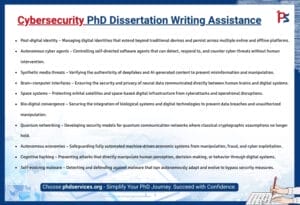
- Cybersecurity Research Challenges
We uncover research challenges in cybersecurity by systematically analyzing emerging threats, vulnerabilities, and evolving attack patterns. Our experts monitor trends such as zero-day exploits, encryption weaknesses, and network intrusions to identify critical areas requiring further study. Using structured approaches like risk assessment frameworks, and creating security models, we evaluate the severity, impact, and research gaps of these challenges.
Emerging threats and evolving technologies create ongoing challenges for cybersecurity research. Meeting these challenges encourages development of new solutions.
Challenges that are often addressed in cybersecurity are:
- Post-digital identity – Managing digital identities that extend beyond traditional devices and persist across multiple online and offline platforms.
- Autonomous cyber agents – Controlling self-directed software agents that can detect, respond to, and counter cyber threats without human intervention.
- Synthetic media threats – Verifying the authenticity of deepfakes and AI-generated content to prevent misinformation and manipulation.
- Brain–computer interfaces – Ensuring the security and privacy of neural data communicated directly between human brains and digital systems.
- Space systems – Protecting orbital satellites and space-based digital infrastructure from cyberattacks and operational disruptions.
- Bio-digital convergence – Securing the integration of biological systems and digital technologies to prevent data breaches and unauthorized manipulation.
- Quantum networking – Developing security models for quantum communication networks where classical cryptographic assumptions no longer hold.
- Autonomous economies – Safeguarding fully automated machine-driven economic systems from manipulation, fraud, and cyber exploitation.
- Cognitive hacking – Preventing attacks that directly manipulate human perception, decision-making, or behavior through digital systems.
- Self-evolving malware – Detecting and defending against malware that can autonomously adapt and evolve to bypass security measures.
- Digital immortality – Protecting persistent digital personas and information assets that continue to exist indefinitely online.
- AI-generated exploits – Addressing threats from exploits and attack strategies automatically created by artificial intelligence systems.
- Metaverse security – Securing persistent, immersive virtual worlds and protecting users from digital theft, harassment, or identity compromise.
- Swarm intelligence attacks – Defending against coordinated attacks launched by multiple autonomous agents acting together.
- Zero-human systems – Ensuring security in fully automated infrastructures that operate without any human oversight or intervention.
- Reality authentication – Developing methods to reliably distinguish between physical reality and digitally constructed or simulated environments.
- Emotion-sensing systems – Protecting sensitive affective and biometric data collected by emotion-recognition technologies from misuse.
- Time-shifted attacks – Countering attacks that exploit delayed vulnerabilities or use time-based triggers to maximize damage.
- Autonomous law enforcement – Governing machine-driven policing systems to ensure accountability and lawful decision-making.
- Post-privacy societies – Redefining cybersecurity strategies in societies where individual privacy is minimal or largely absent.
Empowered by 19+ years of proven research excellence and backed by a highly experienced technical expert team, PhDservices.org delivers innovative, reliable, and customized research solutions to overcome all types of academic and technical challenges. From topic selection, proposal development, methodology design, implementation, analysis, and result validation to final dissertation submission, we provide complete end-to-end support with precision, quality, and research-driven strategies to help scholars achieve outstanding academic success and publication-ready outcomes.
- Cybersecurity Dissertation Ideas
When it comes to developing innovative Cybersecurity dissertation ideas, we guide scholars in identifying research areas that are highly relevant, technically advanced, and academically impactful. Our experts apply bibliometric analysis techniques and utilize advanced tools such as threat intelligence platforms and Wireshark to identify and map emerging cybersecurity research trends. With the support of reference management platforms like Zotero and Mendeley, we systematically organize, evaluate, and refine potential research ideas. Through PhDservices.org Cybersecurity PhD dissertation writing assistance, we deliver innovative dissertation ideas that are academically rigorous, practically relevant, and positioned to make meaningful contributions to the cybersecurity research domain.
Developing creative approaches for advanced research supports dissertation work in cybersecurity. These approaches enable original contributions through in-depth analysis, experimentation, and theoretical development.
Promising ideas for dissertation are:
- Security investment cost–benefit
- Cyber risk transfer economics
- Incentives for secure behavior
- Market failure in cybersecurity
- Security ROI measurement
- Economic impact of breaches
- Security service pricing models
- Defense resource optimization
- Cybercrime economic deterrence
- Incident recovery cost modeling
- Insurance-driven behavior change
- Security budget allocation
- Vulnerability disclosure economics
- Externalities of cyberattacks
- Automation cost efficiency
- Resilience investment economics
- Cyber risk market pricing
- Attacker–defender economic games
- Investment prioritization models
- Sustainable security operations
- Compliance cost analysis
- Secure software market incentives
- Valuation of digital trust
- Downtime loss modeling
- Privacy–cost trade-offs
- Digital ecosystem resilience
- Security decision frameworks
- Economics of talent shortages
- Legacy system cost risks
- Long-term policy economics
- Interactive One-to-One Research Support Session
Call us – +91 94448 68310
Whatsapp – +91 94448 68310
Mail ID – phdservicesorg@gmail.com
URL – PhDservices.org
- Dissertations Completed with Excellence

| Post Doctorate Dissertation | Doctoral Dissertation | Paper writing | Master Dissertation |
| 510 + | 940 + | 1575 + | 1905 + |
- Organized Structure and Chapter Arrangement in Cybersecurity PhD Dissertation
We ensure that each chapter logically builds on the previous one, presenting research coherently. Our specialists guide students in organizing content, including discussions, conclusions, and future work, to highlight technical contributions. This following systematic structure enhances readability, academic rigor, and the overall impact of the PhD dissertation.
- Front page and author credentials
- Dissertation title replicating research focus.
- Name of the author, department, university, date, and supervisor credentials
- Overview
- Concise summary of research objectives, methodology, results, and contributions.
- Highlights technical novelty and impact across relevant computer science domains.
- Unit 1: Introduction & Study Motivation
- Background, contextual relevance, and motivation for research.
- Problem statement, objectives, scope, and research questions.
Overview of technical approach and methodology.
- Unit 2: Gap Analysis
- Comprehensive evaluation of prior work in cyber defense, encryption techniques, threat intelligence, vulnerability assessment etc.
- Identification of research gaps, unresolved technical challenges, and opportunities.
- Unit 3: Research Framework
- Detailed description of algorithms, system architecture, experimental pipelines, and computational models.
- Metrics, parameter selection, reproducibility protocols, and technical diagrams/pseudocode.
- Unit 4: Procedural Setup
- Datasets, hardware/software environments, frameworks, and simulation tools.
- Stepwise experimental procedures with validation and testing strategies.
- Unit 5: Performance Analysis
- Presentation of findings using graphs, plots, and tables.
- Performance evaluation: accuracy, runtime, scalability, security, and resource utilization.
- Comparative study with benchmarks or previous work.
- Unit 6: Technical Perspectives
- Interpretation of results and theoretical implications.
- Challenges, limitations, optimizations, and correlation with expectations.
- Unit 7: Final Remarks
- Summary of contributions and research impact.
- Recommendations for further research or system improvements.
- Assertions
- Originality report and adherence of plagiarism.
- Acknowledgement of academic and technical guidance
- Phase of Illustrations
- Hierarchical table of contents for easy navigation.
- Lists of figures, tables, algorithms, or code snippets.
- Annexures
- Supplementary material such as source code, extended tables, algorithms, logs, or experimental outputs.
- References
- Standard IEEE/APA style citations for all research papers, datasets, and software tools.
- Modeling and Simulation Frameworks in PhD Cybersecurity Dissertation
Simulation frameworks play a vital role in Cybersecurity PhD dissertation research by enabling the evaluation of complex systems, cyber threats, and defense mechanisms in controlled environments. Our experts guide scholars in designing robust and accurate simulation models to assess security protocols, attack scenarios, and protective strategies with technical precision. With PhDservices.org Cybersecurity PhD dissertation writing assistance, we ensure simulation frameworks are implemented using realistic datasets, advanced algorithms, and performance evaluation metrics to achieve reliable, reproducible, and impactful research outcomes.
Simulation environments are utilized to model attacks, defenses, and system interactions safely.
The subsequent list introduces the benefits of simulation tools:
- Simulation tools enable safe testing of cyberattacks and defense strategies without risking real systems.
- Cuts cost and time versus real-world test setups.
- Enables controlled evaluation of security mechanisms.
- Allows analysis of complex attack scenarios.
Popular simulation tools in this area are:
- NS-3 – A discrete-event network simulator used to model network protocols, attacks, and traffic behavior.
- OMNeT++ – A modular network simulation framework for designing and testing secure communication networks.
- GNS3 – A network emulation tool to simulate routers, switches, and cybersecurity scenarios in real time.
- CyberVAN – A virtual environment for simulating network attacks, defenses, and security policies.
- NetLogo – An agent-based modeling tool for simulating malware propagation, botnets, and attack strategies.
- Mininet – A lightweight network emulator to create and test secure network topologies.
- SEED Labs – A cybersecurity teaching and simulation platform for hands-on experiments in attacks and defenses.
- CORE (Common Open Research Emulator) – Simulates virtual networks to test intrusion detection, malware spread, and security policies.
- NS-2 – An older discrete-event network simulator for modeling network security protocols and attacks.
- Cytoscape – A network visualization tool used to simulate and analyze attack paths and threat propagation.
Along with the above-listed tools, PhDservices.org offers advanced technical resources, simulation environments, and data analysis strategies tailored to your research requirements for building a strong and effective dissertation framework. Our expert team provides customized methodologies, implementation support, result validation techniques, comparative analysis models, and performance evaluation metrics to ensure accurate, reliable, and impactful research outcomes. With end-to-end technical guidance, we help scholars strengthen research quality, improve dissertation originality, and achieve publication-ready academic success.
- Testimonials
- China – Dr. Wei Zhang
“Choosing PhDservices.org for my Cybersecurity PhD dissertation was the right decision. Their expert guidance in cyber threat analysis and security framework development gave my research strong technical depth and originality.”
- Netherlands – Dr. Lucas Van Dijk
“The structured research methodology and result validation support made my dissertation journey smoother and academically stronger.”
- Qatar – Dr. Ahmed Al Thani
“The support in advanced security models and simulation frameworks strengthened my research quality and publication readiness.”
- Canada – Dr. Ethan Williams
“The technical team at PhDservices.org helped me improve my cybersecurity architecture, comparative analysis, and result accuracy effectively.”
- United Kingdom – Dr. Oliver Harris
“The implementation guidance and technical expertise made handling complex cloud and blockchain security challenges much easier.”
- London – Dr. Sophia Bennett
“The complete dissertation support improved my research quality, originality, and helped me achieve successful academic outcomes.”
- Free Expert Support with Your Dissertation
With PhDservices.org expert Cybersecurity PhD dissertation writing assistance, scholars gain access to a complete research support ecosystem designed to strengthen implementation quality, technical accuracy, and academic excellence. From structured revisions and technical consultations to publication support and quality validation, our specialized services ensure a seamless, result-oriented, and publication-ready dissertation journey.
- Comprehensive Revision Management
We provide structured revision support to refine and enhance your dissertation in accordance with supervisor feedback, academic standards, and submission requirements.
- Advanced Technical Consultation
Our research experts conduct in-depth technical consultation sessions to strengthen your understanding of methodologies, implementation strategies, and research frameworks.
- Research Originality Assessment
Each dissertation is verified through originality assessment to ensure authentic, plagiarism-free, and academically credible research content.
- AI Content Compliance Verification
We provide AI-based content evaluation reports to validate content authenticity and maintain high standards of academic integrity.
- Professional Language & Quality Review
Our quality assurance process includes detailed grammar, language refinement, and academic structuring to enhance clarity, precision, and presentation quality.
- Confidential Research Security Assurance
We maintain complete confidentiality and secure management of your research data, ideas, and dissertation documents throughout the process.
- Live Project Presentation Support
Our live demonstration sessions help scholars understand implementation flow, result interpretation, and technical presentation for academic evaluation.
- Scholarly Publication Assistance
We support manuscript preparation, journal formatting, and submission guidance to improve publication readiness and academic visibility.
- FAQ
- How do you help identify trending topics in PhD Cybersecurity dissertation?
We monitor recent publications, industry reports, and emerging threats to suggest dissertation topics that are current, original, and impactful.
- Can real-time intrusion detection be implemented in cybersecurity PhD Dissertation?
Yes. We apply AI-driven intrusion detection techniques and privacy-preserving frameworks to enable real-time monitoring while protecting sensitive data in your dissertation.
- Will you help with risk assessment and mitigation analysis in cybersecurity PhD dissertation?
Absolutely. Our experts evaluate vulnerabilities, potential attack surfaces, and mitigation strategies to strengthen the practical relevance of the research.
- How do you handle the integration of multiple frameworks in cybersecurity PhD dissertation?
Our specialists help combine frameworks, tools, and protocols in a cohesive methodology to address complex research challenges.
- How do you ensure reproducibility in Cybersecurity experiments in PhD dissertation?
We document datasets, configurations, simulation parameters, and experimental steps to guarantee that results can be consistently replicated.
- Can you guide in presenting simulation and experimental results?
Yes, we assist in designing tables, charts, and graphs that clearly communicate findings without oversimplifying technical details.
- Supporting Scholars Across Diverse Research Disciplines
Cybersecurity | Network Security | Wireless Sensor Network | Wireless Communication | Network Communication | Satellite Communication | Telecommunication | Edge Computing | Fog Computing | Optical Communication | Optical Network | Cellular Network | Mobile Communication | Distributed Computing | Cloud Computing | Computer Vision | Pattern Recognition | Remote Sensing | NLP | Image Processing | Signal Processing | Big Data | Software Engineering | Wind Turbine Solar | Artificial Intelligence | Machine Learning | Deep Learning | AI LLM | AI SLM | Artificial General Intelligence | Neuro-Symbolic AI | Cognitive Computing | Self-Supervised Learning | Federated Learning | Explainable AI | Quantum Machine Learning | Edge AI / TinyML | Generative AI | Neuromorphic Computing | Data Science and Analytics | Blockchain | 5G Network | VANET | V2X Communication | OFDM Wireless Communication | MANET | SDN | Underwater Sensor Network | IoT | Quantum Networking | 6G Networks | Network Routing | Intrusion Detection System | MIMO | Cognitive Radio Networks | Digital Forensics | Wireless Body Area Network | LTE | Ad Hoc Networks | Robotics and Automation | Signals and Systems | Forensic Science | Psychology | Public Administration | Economics | International Relations | Education | Commerce | Business Administration | Physics | Chemistry | Mathematics | Computational Science | Statistics | Biology | Botany | Zoology | Microbiology | Genomics | Molecular Biology | Immunology | Neurobiology | Bioinformatics | Marine Biology | Wildlife Biology | Human Biology