


Digital forensics is the application of identification, preservation, documentation, extraction, and analysis of forensic information to the courts and administration. This article will provide you a complete picture of digital forensics projects, their merits, and the demands of the subject over researchers. Let us first start with the basics of digital forensics technology!!!
What is Digital Forensics Technology?
Digital forensics is a comparatively recent scientific discipline that entails identifying, validating, investigating, recovering, as well as providing facts in crimes involving digitized evidence obtained on computers and electronic media.
Furthermore, the data is saved or, in that same instance, disguised in different applications or programs. Criminal justice employees may lack the knowledge and resources to extract this data and then use that to convict perpetrators.
As a result, trained individuals like forensic science experts are required. We have been guiding digital forensic projects for the past 15 years and so we have gained enough experience in handling all kinds of problems associated with digital security. You can talk to our experts at any time to get your queries resolved. Let us not talk about the digital forensics taxonomy
Taxonomy of Digital Forensics
The system of digital forensics involves the following aspects
- Acquiring evidence and logistics
- Sources (disk, memory and network)
- Techniques used (agent based and hypervisor based)
- Analysis
- Analysing the evidences and meta data obtained
- Trustworthiness
- Reliability of evidences and the mechanism followed
- Legal implications
- Privacy policies and cross-border laws
- No relationship among evidences
- Identifying the event and associated evidences
- Collecting and analysing proofs
- Interpretation and presentation of the obtained data
It is indeed a critical task for a fresher to overcome the digital forensics projects challenges mentioned above. In such cases research scholars and students readily reach out to reliable project guidance facilities like ours for better information and expert advice. We are one among such few best research supporters in the world. Let us now talk about the selection of appropriate project topic
How to select the latest project topic?
While selecting your project topic you should give much importance to the latest innovations so as to stay in line with the present and future growth in the field. In this respect, you shall consider the following points for selecting the latest digital forensics project topics suitable for your research
- First be sure to Select the technologies – Selecting a emerging technology is a difficult task and it demands deep analysis
- Decision-Making – – It is indeed a group decision. Be really sure to think about everything, particularly the team’s past knowledge
You shall reach out to us for any kind of technical assistance related to your research project from a selection of topics, writing proposals, research papers, thesis, and assignments to final submission. We have dedicated teams of experts to support you in all aspects. What are the emerging technologies of digital forensics?
Emerging Technologies of Digital Forensics
The following are some of the most important digital forensic emerging technologies
- Smart grid applications
- Unmanned aerial vehicles and smart vehicles
- Digital forensics in internet of things applications and artificial intelligence
- Ensuring security and privacy of software
- Big data and blockchain technology in digital forensics
- Code semantics
- Automated buildings for smart living
Researches in the above fields have grown exponentially these days owing to their immense importance. We have also successfully delivered a lot of digital forensics projects based on the above ideas. Hence we are here to solve all your project doubts and support you in a better way. Let us now talk about the recent digital forensics project topics
List of Latest Digital Forensics Projects Topics
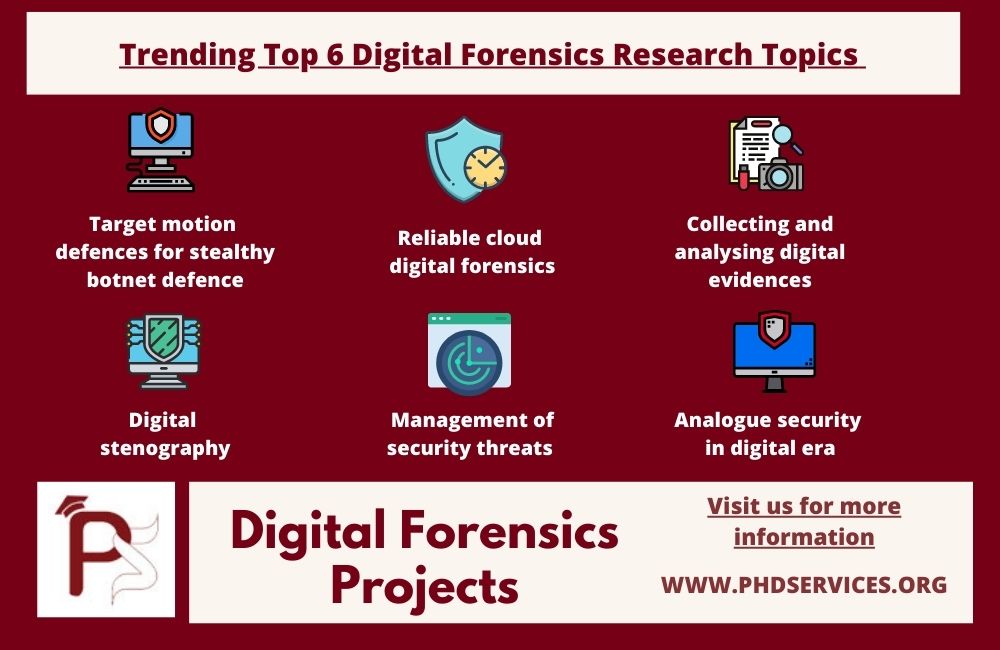
- Target motion defences for stealthy botnet defence
- Reliable cloud digital forensics
- Digital stenography (for investigation purposes)
- Collecting and analysing digital evidences
- Methods for assessment and management of security threats
- Analogue security in digital era (internet and crime science)
At present we are providing support on all the above topics. You shall choose your topic based on your interest or you can also come up with your own ideas and have a talk with our experts to get tips on how to implement them in real-time. As we gained expertise in the field of digital forensics, we would like to mention our specialist skills below.
Our Experts Skills for Digital Forensics Projects
Our technical team and research expert have gained world-class certification on all the following skills related to digital forensics
- Computation and Technical Proficiency
- Without a question, digital forensics is a professional discipline
- We are also working on a wide range of technologies, including networking, processors, mobiles, laptop, server, Wi-Fi, software platforms and router
- In practice, you’ll need to be capable of dealing with software or hardware among a variety of platforms
- If you come through something new, you’ll have to react and utilize your practical understanding
- Organizing abilities
- Technicians must arrange information and communicate it to someone else as part of their job
- As a result, the technician must be well-organized both emotionally and cognitively
- Expertise in Cybersecurity
- Even though those are not forensic science technical skills, they are nonetheless useful considering digital forensics could include investigating cyberattacks
- Thus it’s critical that technicians understand both how to solve problems and then how to minimize issues.
- Remember that as leading the investigation, they must retain their personal data securely.
- Ability to communicate
- Working as part of a team is essential in this area
- You’ll also have to convey your observations, whether or not they’re made explicit
- As an outcome, you must be able to express yourself simply and effectively
- Investigative and research capabilities
- One of the most significant abilities you’ll need as a digital forensic specialist is the ability to study and critically examine any material
- In reality, this would take up significant amount of time
- The objective is to summarily and effectively identify patterns and manipulate information
So you can readily reach out to us for any kind of technical assistance for your research and digital forensics project. Let us not talk about the methodologies used for handling evidence in digital forensics.
What are the techniques for evidence handling?
- Enhancing the space for storage
- In order to effectively seek and analyze large quantities of data, investigators’ analytical machines should have adequate computational power and sufficient storage space
- In this regard the following systems and technologies are useful in enhancing storage space
- Apache spark, Apache storm and Apache Yarn
- Hadoop MapReduce
- There are also many other tools existing for this purpose of improving storage capacity
- Encryption
- Without any right key or passcode, decrypted data could be hard to access
- Researchers must keep in mind that the password or key could be saved on the device on other machine that the accused has knowledge to
- It can also be stored in a device’s memory buffer or RAM, that is normally discarded when the machine is powered off
- This is yet another rationale to use real-time methods for acquisition. Some of the important encryption techniques are listed below
- Symmetric encryption
- Public key (RSA, Diffle, Hellman and others)
- Asymmetric encryption
- Private key
- Block ciphers (AES, DES, Blow Fish and others)
- Stream ciphers (RC4, TKIP and others)
- Private key
- Symmetric encryption
- Novel technologies
- The following are some recent technologies that are making huge impact on digital forensics projects
- Blockchain and HoloChain technologies
- HoneyPot virtualisation
- Lightweight cryptography
- Firewall
- Various security mechanisms
- The following are some recent technologies that are making huge impact on digital forensics projects
For reliable and authentic research resources from top benchmark journals, you can contact our customer support team. You will be guided to have interaction with our research support team and then you can get a better idea of any kind of technologies involved in digital forensics. The following is a brief technical note on one of our best projects in digital forensics.
Best Digital Forensics Projects using Hadoop MapReduce
Here is a detailed description of one of our successful forensic project using Hadoop MapReduce.
- The project consists of four layers for data source, storage, processing and output
- In the first layer of data source the information is obtained from various places (emails, social media, customer database and so on)
- In the next layer associated with storage Hadoop distributed file system is used to store the gathered data
- In the processing and analysis layer MapReduce tool is used for analysing and processing the information
- The final step associated with data output provides for data outputs in the form of figures, reports, charts and so on
As a result, such successful digital forensics projects were delivered by our technical experts using the Hadoop MapReduce platform. Let us now talk in detail about anti-forensics
- The process of trying to evade digital forensic investigation is known as anti-forensics
- This could include encrypting, content duplicating to make it untraceable, metadata manipulation, and file concealing or disguising files
- The proof that such measures were employed, like encryption, could be saved anywhere else on the system or on another machine that the culprit had access
In our experience, we have employed anti-forensics tactics effectively and consistently enough just to completely conceal either the existence of proof. We made successful attempts that were used to disguise and are quite easy to spot earlier. Hence the various aspects of anti-forensics include the following
- Destroying evidence
- Evidence detection and VM termination
- Obfuscation
- Modification of file headers
- Altering log files
- Scrambling the timestamps in the files
- Data hiding
- Encryption methods
- Covert channels
- Compromise on evidence integrity
- Evidences are modified
- Circumventing VM isolation
- Side and covert channels
We have delivered a number of projects in digital forensics involving anti-forensic mechanisms. We have also implemented the meaning of a project in real-time and have gathered performance-related data of all of them. So once you reach out to us we’ll provide you the analytical and comparative technical data on our projects. Now let us see the important digital forensic tools
What are the different types of digital forensics tools?
- Digital forensic techniques are software programs that aid in the preservation, identification, extraction, and documentation of computerized legal evidence
- These tools have made digital forensics basic and straightforward
- These programs often provide appropriate documentation for judicial proceedings
The following are the most common types of digital forensic tools,
- Disc and network forensic tools
- Wireless and memory forensic tools
- Forensic tools for mobile phones
- Email malware and database forensic tools
Generally, research scholars from around the World approach us regarding the creation of innovative tools based on their own idea. Usually, our research experts provide enough technical data, simple practical explanations, tips on writing algorithms, codes and real-time implementation, and many more. As a result, successful and novel projects are being delivered by us. Let us now talk about the software tools that are best for digital forensics
Which are the Best Digital Forensic Software Tools?
- Sleuth Kit, CAINE and EnCase
- FTK imager and Wireshark
- ProDiscover Forensic and Wireshark
- Framework of volatility
In the meantime meaning other forensic software tools have also been developed. Reach out to us regarding all the merits and demerits of these software tools. Now let us understand the important criteria for selecting the best digital forensic tool that is suitable for your project.
Which factors are required while selecting a Digital Forensic Tool?
Consider the following aspects before Selection of any digital forensic tool
- Security and multiple platform support
- Interfaces that are easy to use
- Various features and functions provided
- Supporting various devices and file formats
- Integrations, characteristics of analysis and support multiple plugins
As we have worked on many important digital forensic tools, software, and platforms we are very well experienced and knowledgeable to guide you throughout your research career. Let us now look into the major parameters used for evaluating the performance of any digital forensic projects.
Performance Metrics in Digital Forensics
- Enhanced performance – Timely location of interested data on certain nodes
- Scalability – allowing for addition of hardware to enhance the performance and capacity
- Reliability – Recreation of original information from the existing nodes
- Greater availability – detection of errors, automated recovery, fault tolerance, monitoring scheme incorporation and network failure
These parameters are based on the expectations posed by the users over any digital forensics system. We are glad to claim that all our projects successfully met the objectives and demands stated above. Therefore you can confidently contact us for your digital forensics projects support. We ensure to give you ultimate research assistance.