


Numerous IoT devices and protocols are enabled by NetSim that is referred to as a robust network simulator. It is possible to simulate IoT networks and examine performance indicators using the IoT extension of NetSim. The following are a few interesting project plans which employ the functionalities of NetSim in an extensive way:
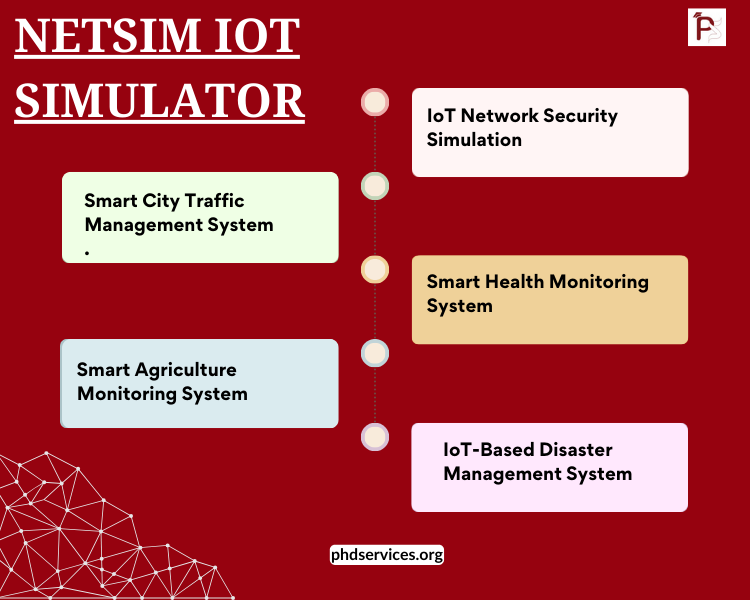
- Smart City Traffic Management System
- Summary:
- Through the utilization of traffic signals and IoT sensors, a smart city traffic handling system has to be simulated.
- Consider the tracking of realistic traffic data and the enhancement of traffic flow.
- Procedures:
- In the beginning, a network of traffic light controllers and traffic cameras should be developed.
- For transmitting traffic data to a major server, arrange IoT nodes.
- To forecast traffic patterns and adapt traffic signals in an appropriate way, employ data analytics.
- NetSim Arrangements:
- Network Setup:
- For interaction, use Wi-Fi or cellular networks.
- Utilize traffic signals and traffic cameras like IoT devices.
- Protocol Assistance:
- Major protocols such as CoAP and MQTT for data interaction.
- Potential Research:
- Forecasting and enhancement of traffic.
- Tracking of energy utilization, packet delivery ratio, and latency.
- Smart Agriculture Monitoring System
- Summary:
- By employing IoT sensors for temperature and soil moisture, a smart agriculture tracking system must be created.
- For the enhancement of irrigation, apply predictive analytics.
- Procedures:
- A network of temperature and soil moisture sensors has to be simulated.
- For long-range interaction, utilize different protocols such as Zigbee or LoRa.
- In order to forecast irrigation requirements, construct an analytics module.
- NetSim Arrangements:
- Network Setup:
- Consider temperature, soil moisture sensors as IoT devices.
- For interaction, use protocols like Zigbee or LoRa.
- Protocol Assistance:
- Zigbee and LoRaWAN.
- Potential Research:
- Focus on data visualization and irrigation forecasting.
- Track various metrics such as energy utilization, latency, and packet delivery ratio.
- IoT-Based Smart Home Automation System
- Summary:
- Using MQTT-based sensors and actuators, create an efficient smart home automation system.
- Concentrate on the simulation of safety systems, smart lighting, and heating.
- Procedures:
- Plan to simulate a network of various smart devices such as safety cameras, thermostats, and smart bulbs.
- For enabling interactions among a major control system and devices, employ an MQTT broker.
- On the basis of user choices and actual-time data, regulate devices by developing an automation framework.
- NetSim Arrangements:
- Network Setup:
- Deploy safety cameras, thermostats, and smart bulbs as IoT devices.
- Specifically for interaction, use Zigbee or Wi-Fi networks.
- Protocol Assistance:
- CoAP and MQTT.
- Potential Research:
- Assessment of automation effectiveness and energy preservations.
- Tracking metrics like energy usage, packet delivery ratio, and latency.
- IoT Network Security Simulation
- Summary:
- Through the use of different devices, simulate an IoT network effectively. Major safety risks have to be examined.
- For identifying abnormalities, an intrusion detection system (IDS) must be applied.
- Procedures:
- Along with different devices such as cameras and sensors, develop IoT networks.
- Various safety assaults such as replay assaults, packet sniffing, and DOS have to be established.
- In order to identify and react to assaults, create a robust IDS.
- NetSim Arrangements:
- Network Setup:
- Examine actuators, cameras, and sensors as IoT devices.
- It is approachable to use Zigbee or Wi-Fi network for the purpose of interaction.
- Protocol Assistance:
- MQTT and CoAP.
- Potential Research:
- Assessment of IDS’s efficiency.
- On packet delivery ratio and latency, track the effect of assaults.
- Smart Health Monitoring System
- Summary:
- Employ wearable IoT devices for the creation of a smart health tracking system.
- The major objective is to track health data in actual-time. In terms of any abnormalities, notify healthcare experts.
- Procedures:
- A network of wearable health monitors must be simulated, including ECG and heart rate sensors.
- For gathering and processing health data, utilize an MQTT broker.
- To identify health problems at the early stage, apply anomaly identification.
- NetSim Arrangements:
- Network Setup:
- Consider ECG and heart rate sensors as IoT devices.
- For interaction, use Wi-Fi networks.
- Protocol Assistance:
- CoAP and MQTT.
- Potential Research:
- Assess the preciseness of the anomaly identification system.
- Tracking of different metrics like energy utilization, packet delivery ratio, and latency.
- IoT-Based Disaster Management System
- Summary:
- As a means to identify and react to various natural disasters such as floods or earthquakes, create an IoT-related disaster management system.
- For early notifications, a network of water level and seismic sensors should be simulated.
- Procedures:
- With the support of Zigbee or LoRa, develop a network of water level and seismic sensors efficiently.
- In terms of actual-time sensor data, forecast disasters by constructing an analytics framework.
- To alert emergency contacts, apply a warning system.
- NetSim Arrangements:
- Network Setup:
- As IoT devices, employ water level, seismic sensors.
- Utilize Zigbee or LoRa network for the objective of interaction.
- Protocol Assistance:
- Zigbee and LoRaWAN.
- Potential Research:
- Assessing the exactness of the disaster management system.
- Track major metrics such as latency, packet delivery ratio, and energy usage.
Does the NS 3 simulator support the LoRa and the Adaptive Data Rate feature in the LoRa?
Yes, LoRa and Adaptive Data Rate (ADR) characteristics are assisted by an NS-3 simulator with the aid of supplementary modules and libraries. Based on how NS-3 assists LoRaWAN and ADR, we offer general explanations in an explicit manner:
Assistance for LoRa in NS-3
- NS-3 LoRaWAN Module
- The NS-3 LoRaWAN module is considered as an extension. For LoRaWAN in NS-3, it offers extensive assistance.
- Various fundamental LoRaWAN-based characteristics such as the ADR characteristic, LoRa MAC layer, and Class A devices are encompassed in this module.
Characteristics of the NS-3 LoRaWAN Module
- LoRa MAC Layer:
- On the basis of the LoRa Alliance requirements, it applies the LoRaWAN MAC layer.
- LoRa PHY Layer:
- It specifically designs data rates, spreading factors (SF), and LoRa PHY modulation.
- Adaptive Data Rate (ADR):
- For the adjustment of uplink data rate, it enables ADR techniques.
How to Utilize the LoRaWAN Module in NS-3?
- Installation Process:
- Initially, copy the loRaWAN module. Within the NS-3 simulator, combine it appropriately.
# Clone the NS-3 LoRaWAN module
git clone https://github.com/iot-simulator/ns-3-lorawan.git
# Navigate to the NS-3 directory and integrate the LoRaWAN module
cd ns-3-allinone/ns-3-dev
cp -r path/to/ns-3-lorawan/lorawan.
- Set up and Develop NS-3:
- Set up and develop NS-3, once combining the module.
./waf configure –enable-examples –enable-tests
./waf build
- Instance of LoRaWAN Simulation Script:
- By depicting LoRaWAN with ADR, the following is an instance of simulation script (simple-loeawan.cc).
#include “ns3/lorawan-module.h”
#include “ns3/core-module.h”
#include “ns3/network-module.h”
#include “ns3/mobility-module.h”
using namespace ns3;
int main (int argc, char *argv[])
{
// Create a simple LoRaWAN network
NodeContainer endDevices;
endDevices.Create (10);
NodeContainer gateways;
gateways.Create (1);
// Configure Mobility
MobilityHelper mobility;
mobility.SetPositionAllocator (“ns3::UniformDiscPositionAllocator”,
“X”, DoubleValue (5000),
“Y”, DoubleValue (5000),
“rho”, DoubleValue (5000));
mobility.SetMobilityModel (“ns3::ConstantPositionMobilityModel”);
mobility.Install (endDevices);
mobility.Install (gateways);
// Create LoRaNetDevices
LoRaHelper lorawan;
NetDeviceContainer endDeviceNetDevices = lorawan.Install (endDevices);
NetDeviceContainer gatewayNetDevices = lorawan.Install (gateways);
// Enable ADR lorawan.SetAdaptiveDataRate (true);
// Create the Network Server and Join Server lorawan.CreateNetworkServer (gateways);
lorawan.CreateJoinServer (gateways);
// Schedule Packet Generation lorawan.ScheduleDataTransmission (Seconds (1), Seconds (10));
Simulator::Stop (Seconds (20));
Simulator::Run ();
Simulator::Destroy ();
return 0;
}
- Execute the Simulation:
- In order to validate the capability of LoRa and ADR, construct and execute the simulation in an efficient way.
NETSIM IOT Simulator Projects
For over 18+ years, phdservices.org has been offering online guidance to scholars. With a track record of assisting nearly 8000+ NETSIM IOT Simulator Projects, we have established ourselves as a reliable source of support. Take a look at the topics we have recently been assisting scholars with. Our team of experts will help you choose and refine the perfect topic based on your areas as per your interest.
- IoT based real-time traffic monitoring system using images sensors by sparse deep learning algorithm
- Reliable cluster based data aggregation scheme for IoT network using hybrid deep learning techniques
- TBVPAKE: An efficient and provably secure verifier-based PAKE protocol for IoT applications
- Toward IoT device fingerprinting from proprietary protocol traffic via key-blocks aware approach
- Impact of IoT and SoS in Enabling Smart Applications: A Study on Interconnectivity, Interoperability and Quality of Service
- QSec-RPL: Detection of version number attacks in RPL based mobile IoT using Q-Learning
- A survey on device fingerprinting approach for resource-constraint IoT devices: Comparative study and research challenges
- Apache Flink and clustering-based framework for fast anonymization of IoT stream data
- IoT-based patient monitoring system for predicting heart disease using deep learning
- A learning-based metaheuristic administered positioning model for 3D IoT networks
- Blockchain-assisted computation offloading collaboration: A hierarchical game to fortify IoT security and resilience
- IoT based secured data monitoring system for renewable energy fed micro grid system
- Imbalanced tabular data modelization using CTGAN and machine learning to improve IoT Botnet attacks detection
- A joint strategy for service deployment and task offloading in satellite–terrestrial IoT
- A bandwidth control scheme for reducing the negative impact of bottlenecks in IoT environments: Simulation and performance evaluation
- Seeking at-home long-term autonomy of assistive mobile robots through the integration with an IoT-based monitoring system
- Data compression techniques in IoT-enabled wireless body sensor networks: A systematic literature review and research trends for QoS improvement
- CRSExtractor: Automated configuration option read sites extraction towards IoT cloud infrastructure
- Empowering elderly care with intelligent IoT-Driven smart toilets for home-based infectious health monitoring
- A privacy-preserving scheme to support the detection of multiple similar request-real-time services in IoT application systems