


Rainfall prediction is considered as a difficult task because of the existence of non-linear and inappropriate factors of the environmental aspects. Therefore, for rainfall forecasting, Artificial Neural Networks (ANNs) are used because of their efficiency in building nonlinear frameworks. If you are finding research difficult then contact us and put your worries aside. We run for more than 18+ years and have research scholars working so that the standard and quality of our Rainfall prediction paper can be maintained. Proper references with correct source code will be given and explained on Rainfall prediction topic.
Here, we describe about the fundamental procedures for forecasting rainfall through the utilization of ANNs:
- Data Gathering & Preprocessing:
- Data Sources: Our project makes use of previous rainfall data or utilizes data from meteorological associations, satellites or weather centers.
- Feature Selection: Consideration of other meteorological attributes such as temperature, wind speed, pressure and humidity is important in addition to previous rainfall data. It is crucial to detect which attributes involve more in our forecasting process.
- Data Preprocessing: To maintain the same scale among all input features, we normalize the data by performing Min-Max scaling or Z-score normalization.
- Designing the Neural Network:
- Input Layer: Our work considers an equal number of neurons and input features.
- Hidden Layers: We utilize one or more hidden layers. Based on the complex nature of data, the number of neurons and hidden layers is decided in the analysis phase.
- Output Layer: For categorical forecastings, (like rain or no-rain) our research incorporates two neurons with softmax activation and utilizes one neuron if we forecast rainfall amount for a particular day.
- Activation Functions: We employ linear activation for regression tasks, and softmax for categorization tasks in the output layer and Rectified Linear Unit (ReLu) or its variants for hidden layers.
- Training the Network:
- Loss Function: In this, our work uses Cross-entropy loss for categorization tasks (rain-no-rain) and Mean Squared error (MSE) for regression tasks (forecasting the rainfall amount).
- Optimization Technique: various optimization techniques such as RMSprop, Adam or SGD with momentum are helpful for us.
- Batch Size & Epochs: We decide these hyperparameters in the analysis phase.
- Regularization: To avoid overfitting issues, our task uses methods such as dropout.
- Evaluation:
- To examine our framework’s efficiency, we divide the dataset into three sets such as training, validation and testing.
- Our research considers metrics including accuracy, precision, recall and F1-score for categorization tasks and Root Mean Square Error (RMSE) or Mean Absolute Error (MAE) for regression tasks.
- Model Enhancement:
- Feature Engineering: To enhance forecasting accuracy, we transform the previous features or design novel features.
- Hyperparameter Tuning: Discovery of optimal hyperparameters through the use of methods such as random search or grid search.
- Ensembling: We enhance accuracy by integrating forecastings from various frameworks.
- Deployment:
- After the successful efficiency of our framework, implement it for actual-time forecastings or combine it with other models.
- Limitations:
- Spatial & Temporal variability: Forecasting process is complex for us due to the rainfall’s different nature throughout time or small distances.
- Data Quality: Our project needs high-standard data for accurate rainfall forecasting. The forecasting effectiveness may get affected by missing or corrupted data.
- Future Improvements:
- It is better for us to use the Long Short-Term Memory (LSTM) network (a kind of Recurrent Neural Network (RNN)) specifically for time-series data such as rainfall forecasting because it has the capability that it doesn’t forget previous data.
- To improve forecastings, we employ other data sources like satellite imagery data.
At last, it is very important to obtain standard data and carry out particular feature engineering and hyperparameter tuning processes to accomplish best outcomes when the ANNs have the efficiency to build the complicated non-linearity in rainfall factors.
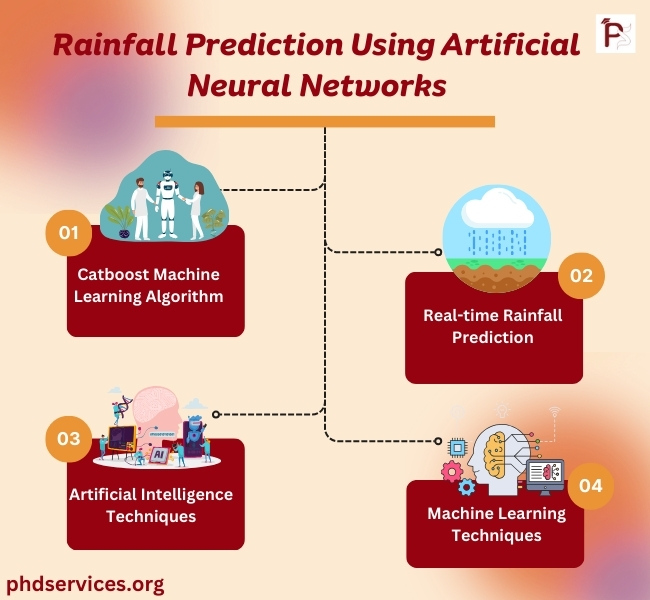
Rainfall Prediction Using Artificial Neural Networks Thesis Ideas
Research usually brings in a lot of distress we give citing relevant sources of the selected Rainfall Prediction topics. A well-crafted thesis topic can be presented only by PhD professionals. But in phdservices.org we have only subject matter doctorls working. All areas of your thesis are covered by us tactically with proper explanation.
- Rainfall Prediction Rate in Saudi Arabia Using Improved Machine Learning Techniques
- Application of Innovative Machine Learning Techniques for Long-Term Rainfall Prediction
- A new rainfall prediction model based on ICEEMDAN-WSD-BiLSTM and ESN
- Impact of the initial stratospheric polar vortex state on East Asian spring rainfall prediction in seasonal forecast models
- Neuro-Fuzzy Model for Quantified Rainfall Prediction Using Data Mining and Soft Computing Approaches
- Extreme Rainfall and Flood Risk Prediction over the East Coast of South Africa
- Multilayer perceptron neural network based models for prediction of the rainfall and reference crop evapotranspiration for sub-humid climate of Dapoli, Ratnagiri District, India
- Rainfall Prediction Model Using Artificial Intelligence Techniques
- Rainfall Prediction Using Catboost Machine Learning Algorithm
- Rainfall Prediction using Regression Model
- Improvement in District Scale Heavy Rainfall Prediction Over Complex Terrain of North East India Using Deep Learning
- Bi-LSTM Model based Real-time Rainfall Prediction
- Leveraging ARMA and ARMAX Time-Series Forecasting Models for Rainfall Prediction
- Accurate Weather Forecasting for Rainfall Prediction Using Artificial Neural Network Compared with Deep Learning Neural Network
- Rainfall Prediction Using Deep Learning and Machine Learning Techniques
- Introducing Temporal Correlation in Rainfall and Wind Prediction From Underwater Noise
- Automatic Rainfall Prediction System using Machine Learning with Extreme Gradient Boost Algorithm
- KGR-Rainfall: Temperature-Based Rainfall Prediction in Bangladesh with Novel KGR Stacking Ensemble
- A Comparative Study of Rainfall Prediction Using Machine Learning Techniques
- Prediction of Rainfall in Karnataka Region using optimised MVC-LSTM Model
- Machine Learning-based Rainfall Prediction from Weather Data: A Comparative Analysis
- Attention-based BiLSTM Model for Rainfall Prediction
- Monthly Rainfall Prediction Based on VMD-GRA-Elman Model
- A rainfall prediction system using Machine Learning (ML) and Internet of Things (IoT)
- An Efficient Rainfall Prediction Model Using Deep Learning Method
- Application and Analysis of Machine Learning Based Rainfall Prediction
- Deep Learning Approach for Heavy Rainfall Prediction Using Himawari-8 And RDCA Data
- Deep Learning-Based Rainfall Prediction Using Cloud Image Analysis
- Rainfall Prediction using Neural Network Model with Autocorrelation Function and Correlation Analysis
- A Stacking Ensemble Learning Model for Rainfall Prediction based on Indian Climate
- Rainfall Prediction using Machine Learning Techniques – A Comparative Approach
- A Comparative Analysis of the Machine Learning Model for Rainfall Prediction in Cavite Province, Philippines
- Performance Evaluation Of Machine Learning Algorithms For Rainfall Prediction Using Dimensionality Reduction Techniques
- An Effective Prediction of Rainfall Using Machine Learning Technique
- Rainfall Prediction Using Azure Automated Machine Learning
- A Machine Learning Approach to Statistical Analysis and Prediction of Rainfall and Drought in the Marathwada Subregion
- IoT-Enabled Weather Monitoring and Rainfall Prediction using Machine Learning Algorithm
- Empirical Analysis of Rainfall Prediction System using an DGRNN-SAM Approach
- A Survey on Using Spatio-Temporal Networks for Rainfall Prediction
- Rainfall Prediction using Artificial Neural Network with Forward Selection Method