


SDN or software defined networks involve a mechanism of centralized control based on managing flow-based traffic. SDN projects using mininet are becoming famous especially due to the efficiency of the latter in both simulation and emulation of SDN. Quick prototyping of networks over one machine and the ability to run the unaltered network application code makes Mininet the best emulation platform to run the experiments of SDN.
- Reconfiguration of real systems is difficult
- Alterations in topology can be easily made in virtual machines
- Issues of scalability persist in such virtual machines
- Simulators are the best tools for deploying source codes
- Performance analysis can be made prior to the actual implementation using simulators
Source simulation tools like mininet have to be involved in modeling large-scale networks to study their practical performance. Hence researchers have to solve the problems associated with such tools.
This article will provide you a complete picture of research in software defined networks especially SDN Projects using mininet. First, let us understand the different components of Mininet.
Mininet Components as Follows
- Mininet provides for Developing, Sharing and Experimenting the SDN projects with the help of P4 and OpenFlow
- Link Emulation – each link has a data rate for shaping traffic which is enforced by Linux traffic control. The virtual Ethernet interface are unique for every emulated host
- Isolation of Hosts – set of processes at the user level all transferred to a network namespace (providing interface, routing tables and Port ownership)
- Emulated Switches – packet switching among different interfaces is possible using open Vswitch (in kernel mode) and Linux Bridge (default). Switches and routers can be run in both user and kernel space
The only points stated above are the characteristic features of mininet as a simulation and emulation tool. Accordingly, the best option for software defined networks simulation could be Mininet. With over 300+ successful projects in software defined networking, our engineers are completely experienced in all aspects of the field. We are therefore highly qualified and skilled to help you do successful SDN projects using Mininet. Now let us understand more about SDN mininet
What is SDN MININET?
- Large network deployment over constrained resources in a single virtual machine is possible using the emulator called Mininet
- In-depth research can be enabled in openflow and SDN using Mininet
- Interactive running off an altered code in virtual mode on a primitive personal computer is possible with mininet
Therefore mininet can make a better analysis of software defined projects. You shall talk to our research experts regarding the merits and constraints associated with Mininet tool. This is because only after understanding both the sides of a Mininet-like simulation tool can you easily conclude its usage. Now let us see the platform based on which mininet works.
On Which Platform is MININET based?
- Based on open Vswitch or also called OVS, mininet is the best switch emulator (and not a Simulator)
- Openflow and customized switches can be used in it
- Configuration on commandline and through python api affects its functioning
- It is an open-source tool for implementing virtual multilayer switch
- Hardware virtualization switching using many standards and protocols in various environments are possible using Open Vswitch
For these purposes that mininet has gained popularity among software defined networking researchers. Generally, our experts provide an accurate answer to the reason for choosing a simulator or emulator to give you the motivation required for in-depth analysis. In this regard latest now see the reasons for choosing mininet
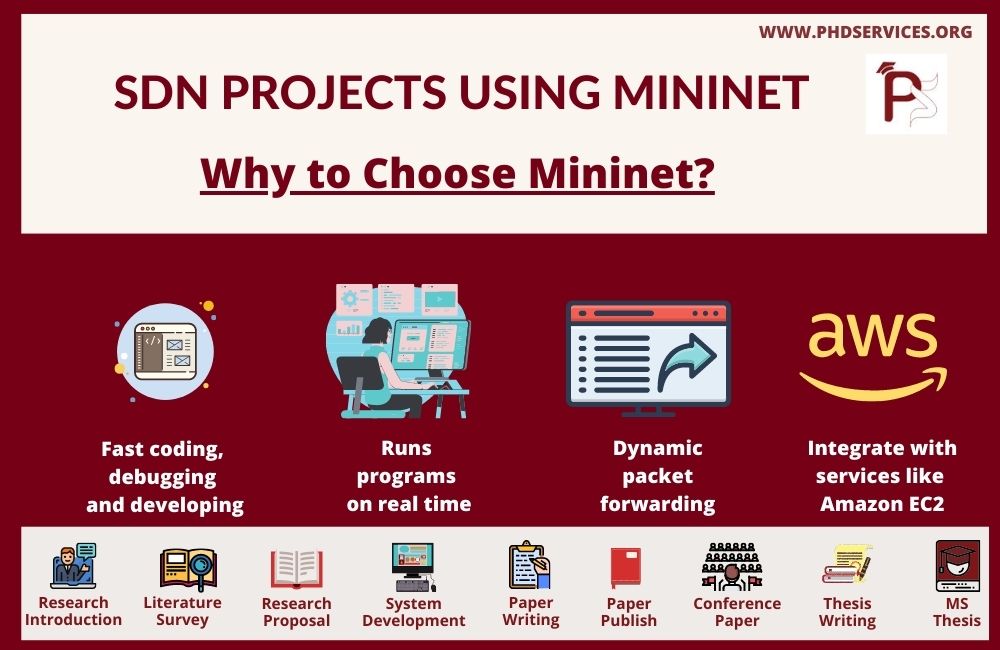
Why to Choose Mininet?
- Mininet is a tool used for fast coding, debugging and developing
- It provides support for customized topology and runs programs on real time
- It allows for flow and dynamic packet forwarding
- You can use this tool on both laptops and service and can be easily integrated with services like Amazon EC2
The libraries and classes involved or are similar to python codes which are directly used in building up the topology. As a result, you can easily finish your project on time using the Mininet. Efforts have been taken by our technical team to make researchers better understand the merits of mininet for which data from authentic sources, research materials, technical details of our successful SDN projects Using Mininet, and so on were given for reference to them. .
USES OF MININET IN SDN
- Mininet helps in producing reliable environment for developing software defined network projects (both in laptops and personal computers where you are allowed to switch among them)
- Mininet provides for seamless functioning in a cost-effective and streamlined manner
- Running of actual hardwires in real-time deployments at linerate is possible with this tool
- It also allows for Quick modeling and prototyping of SDN projects
- By providing the suitable testbed it makes suitable environment for testing complex topology
- Different developers are allowed to use the tool at the same time irrespective of each other
- The tool works on standard and real codes like UNIX and LINUX networks, Network stack and Linux kernel. Experimentation and creation of networks using extensible python API is possible with Mininet
- The enthusiasts belonging to networking and SDN projects community gives the best support for using mininet in BSD open-source license
Usually, research scholars look for expert advice in handling the various aspects of Mininet. We have complete assistance on SDN projects to research scholars and students from top world universities. Along with the above benefits, now we would like to give you some ideas on the functions involved in mininet.
SDN MININET FUNCTIONS
There are several Mininet functions are used to deal with the SDN functions and some of the functions are as follows. Firstly, initialize the network with a set of simulation parameters.
- START () – this function is used to initialize the network
- PINGALL () – this function is used for analysing the testing for all nodes
- STOP () – this function is used to terminate the process of the network.
SDN MININET COMMANDS
As we saw in the above sections, mininet can be used in SDN project simulation and can run a controller for different experiments. openvswitch and OVCS controller are present in default within mininet.
.sudo apt-get install POX/FloodLight
This is the command used for installing the suitable controller. The various useful mininet commands are listed below.
- $ sudo mn – run mininet (as root) and minimal topology and command line interface are denoted in this. Open flow switch on controller among two hosts are also involved
- sudo mn -h – it helps in viewing mininet help menu
- mininet>nodes – current network nodes available for default topology is displayed
- mininet>h1 ping h2 – connection between two hosts are tested with this command until the command is terminated
- mininet >h1 ping -c1 h2 – connection among two different hosts in a packet are checked with this command
- sudo mn -C – completely deletes the previous commands
Apart from these you get many different types of commands in mininet that is useful in SDN project design and development. We help you in implementing codes successfully and efficiently. The codes written by a researcher provide an idea of his expertise. So spend time writing crisp and the best codes. Now let’s talk about SDN mininet topologies.
SDN MININET TOPOLOGIES
The following topologies contained by mininet are useful in various aspects of SDN.
- Single – contains k hosts and openflow switch and establishes connection among them.
#mn–topo single, 4
- Linear – it has both k host and k switches (connection between them also established)
#mn–topo linear, 4
- Minimal – it consists of two hosts and one openflow switch (link between them is also created)
#mn–topo minimal, 4
- Reversed – reverse connection compared to single topology
#mn–topo reversed, 4
- Tree – consists of k levels; two hosts per switch
#mn–topo tree, 3
Using these commands mentioned alongside each topology, you can easily design your own type of topology for SDN projects using mininet. Understanding various commands and their usage becomes an easy task with the support of our technical experts. Now we will give you some ideas on creating custom topology
HOW TO CREATE THE CUSTOM TOPOLOGY?
Mininet provides various simple techniques for creating customized topology. You can easily write small python codes for such processes. The following are the advantages of using mininet for creating custom topology
- Complex codes can be created easily
- Codes are both robust and flexible
- Topology can be reused for different experiments
- Configuration of topologies based on various parameters
- Simpler python like codes
Now let us look into the different codes involved in mininet for custom topology Creation as mentioned below
- build() – topology override
- addHost() – added switch name is returned
- addLink() – bidirectional link is added to topology
- addHost() – added switch host is returned
- Topo – base class
Apart from configuration of topology, mininet also provides sets of codes and commands for processes such as flow rules, routing etc. Our experts have delivered novel and standard projects using various classes of mininet. The following aspects are used in project visualization
- GUI – Mininet and automatic script creation
- Mininet topology visualizer – To support the visualization of topology
The world-class certified research experts with us hang out with the topmost researchers of the globe and with the help of home, you can surely attain success in your research career. What are the major areas of research in software defined networks?
MAJOR RESEARCH AREAS IN SDN
The software-defined network projects are nowadays booming in the following research areas.
- VANET based NDN (controlled by SDN)
- SDN in internet of things, fog and software cloud platforms
- Software defined in sensor networks and VANET driven by SDN
- SDN automatic vehicles, V2X and IoV
- Edge based SDN, SDN/NFV and 5G/6G
Entire research support on all the topics mentioned above is provided by our technical experts. A project is successful only when all its aspects are achieved. In this regard, we also provide you huge support in literature aspects like thesis writing, paper publication, etc along with technical assistance in project design. Now let us understand SDN mininet emulation
HOW TO SIMULATE SDN USING MININET?
The SDN concepts can be easily learned with the help of open flow network devices. The following steps will make you understand the process of emulation of SDN projects with help of mininet.
- First run the command sudo mn
- The network topology associated with different devices and host are obtained
- These are connected to SDN controller
So you can write applications and do experiments with openflow and make use of the commands in mininet and the Software Defined Networking controller to create openflow network topology.
- Quick creation off codes
- Real virtual networks for running kernel codes
- Software application and switch codes can be written on personal computers
Hence the openflow in mininet can help you build different topologies for SDN applications. We are here to provide you theoretical and practical explanations for easy understanding of different concepts associated with SDN projects using mininet. In this respect, we have provided an optimal mininet evaluation result of a project we guided
MININET EMULATION RESULTS
Opendaylight is used as an SDN controller for many of the successful projects that we delivered. For this purpose, we use to employ ODL’S RESTFul API. Consider the following steps involved in the experimentation procedure for using open daylight,
- The preferred topology is first designed on the virtual machine by mininet software
- This is done by connecting OVS instance of mininet to external VM
- Python module is used in collecting information about topology and the capacities of link configuration
- CPLEX solver is run separately so that it is not interfered with ODL
- Model for device power consumption and scenario dependent randomized floors are used for calculating the power consumption at initial stage and current link utilization in non optimized States respectively
- The same technique is used in generating traffic flows and routing functionality
- MIP Salwa is used for configuration of CPLEX with proper optimisation algorithm you can calculate the link utilization and finally the newly designed topology is stored for review in an external file
So in order to conclude let us now list down the various steps involved in mininet emulation results as a gist.
- Mininet topology emulation
- Discovery of topology through SDN controller API
- Theoretically calculating routing algorithm
- Utilizing initial link and power consumption details
- Considering the input file for optimisation
- Use appropriate optimisation algorithm
- Finally calculating the optimal energy
Now let us look into the various parameters involved in SDN mininet emulation
SDN MININET SIMULATION PARAMETERS
- Number of flows and packets
- Average, Minimum and maximum delay
- Deviation from delay standard and average jitter
- Average packet rate, bit rate and the bytes received
- Average loss burst size and error lines
- Total time and packets dropped
- Rate of arrival, simulation and base station processing time
- Open flow switch and SDN controller processing
- Processing time and the time for transmission among different nodes
Usually, we give more preference to make excellent projects that show extraordinary results when evaluated along with the above metrics. So get in touch with our experts for successful project completion.
MININET INTEGRATION TOOLS
- Mininet editor (web based and real-time validation)
- RipL – POX (multipart controller)
- Visual network description (automatic creation and control using mininet)
- IPMininet (used in IP based network python library)
We are here to provide you with a technical explanation supporting research data and analysis on all these integration tools involved in mininet. Hence for your SDN projects using mininet, you can confidently reach out to us. We are sure to give you full support throughout your research career.