


Information Technology (IT) is a fast growing field that particularly contains different types of titles for a thesis. Below, we consider various thesis title strategies that are planned to motivate or be improved based on your research passion throughout several IT areas:
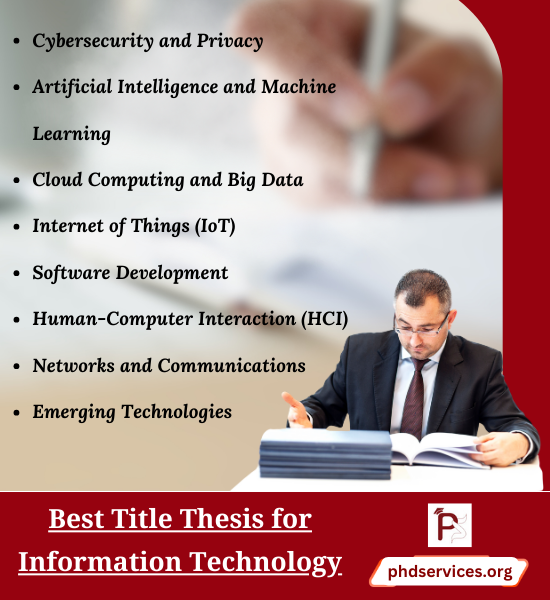
Artificial Intelligence and Machine Learning
- Implementing Machine Learning Algorithms for Early Detection of Cybersecurity Threats
- AI-Driven Predictive Maintenance in Manufacturing: A Performance Analysis
- Enhancing Customer Service Through Natural Language Processing: A Study of AI Chatbots’ Effectiveness
Cybersecurity and Privacy
- Evaluating the Impact of Blockchain Technology on Enhancing Data Security in Cloud Computing
- Assessing Vulnerability to Cyber Attacks in Smart Home Devices: A Case Study Approach
- Privacy-Preserving Techniques in Social Media: An Analysis of User Data Protection Mechanisms
Internet of Things (IoT)
- IoT in Agricultural Efficiency: Analyzing the Impact of Smart Farming Solutions
- Security Framework for IoT Devices in Smart Cities: Design and Implementation
- Energy-Efficient IoT Devices: Developing Sustainable Practices in IoT Networks
Cloud Computing and Big Data
- Scalability Challenges in Cloud Computing: Strategies for Efficient Data Storage and Retrieval
- Big Data Analytics in Healthcare: Improving Patient Outcomes Through Predictive Modeling
- A Comparative Analysis of Cloud Computing Models for Small and Medium-Sized Enterprises (SMEs)
Software Development
- Agile Versus Waterfall: A Comparative Study of Software Development Methodologies
- The Role of DevOps in Enhancing Software Deployment Speed and Operational Efficiency
- Open Source Software Adoption in Enterprises: Benefits, Challenges, and Strategies for Success
Networks and Communications
- 5G Technology: Exploring its Potential in Remote Healthcare Services
- Wireless Sensor Networks for Environmental Monitoring: Design, Implementation, and Analysis
- Quantum Computing’s Impact on Internet Security Protocols: A Future Perspective
Human-Computer Interaction (HCI)
- Virtual Reality as a Training Tool in Medical Education: Effectiveness and User Experience
- Improving Accessibility in Web Design: A Study on Compliance with Web Content Accessibility Guidelines (WCAG)
- The Impact of User Interface Design on User Experience in Mobile Applications
Emerging Technologies
- Blockchain for Transparent Governance: A Study on Its Implementation in Public Sector
- The Role of Augmented Reality in Enhancing Online Education: A Case Study
- Analyzing the Ethical Implications of AI in Employment: Balancing Automation and Human Labor
How to write Dissertation for Information Technology Research?
Writing a specific and well-focused research dissertation seems to be a critical process that requires deep insights in the field of IT. It is advisable to implement some general steps for making this task easier. We provide a procedural flow that supports you to write an effective IT research dissertation:
- Proposal Development
- Topic Selection: Decide a topic which is beneficial to the field of IT as well as intrigues you. It must be anything that you can dedicate novel expertise or perspectives and are curious about.
- Literature Review: This acts as a basis for your research proposal. To find spaces in insights which your dissertation can overcome, organize a complete survey of previous investigation.
- Research Question and Objectives: Summarize the goals of your research by stating the study queries explicitly. Your research plan and methodology will be directed through this process.
- Dissertation Structure
According to the particular necessities of your course or university, the format might differ. But, the following elements are involved in a common IT dissertation:
- Title Page: It includes the title of your dissertation, author name, department, university, degree course and data of submission.
- Abstract: Your study query, methods, main detections and conclusions must be paraphrased in a brief overview which acts as an abstract of the dissertation.
- Table of Contents: Along with the page numbers, all the phases and divisions in your dissertation must be entered in a table format.
- List of Figures and Tables (if suitable): When your dissertation contains any visual representation like charts, diagrams, tables and graphs, list-out them clearly in this phase.
- Acknowledgments (optional): In this section, show your gratitude to the people who assisted you during the exploration.
- Part 1: Introduction: This phase usually presents the topic, context information, research issue, aims and importance of your research in an exact manner.
- Part 2: Literature Review: To design your study query into the background of the previous sense of insights, examine the related literature.
- Part 3: Methodology: Explain your decisions in selecting methods. Your research model, data gathering techniques and analysis approaches should be elaborated clearly.
- Part 4: Results: By implementing charts, tables and graphs, depict both the data and results of your study.
- Part 5: Discussion: You should understand and present the findings. In terms of the previous literature and your research query, describe their significance.
- Conclusion: The conclusion section always provides opinions for upcoming studies, but firstly outlines your study, its dedication to the area, and challenges.
- Citations: In your dissertation, enter all the referenced literary projects here.
- Appendices: It consists of extra resources like program snippets, fresh data and quizzes which assists your exploration.
- Writing Process
- Start Early: To clear any doubts in your ideas, writing during the research is beneficial. Therefore, start writing immediately when you begin the investigation.
- Set a Schedule: Follow the timetable and assign standard duration for the writing work.
- Write in Sections: There is no need to write your dissertation in a sequential way. You can address any one chapter at a specified time.
- Feedback Loop: Get reviews from the mentors frequently and according to their comments refine your process.
- Revising and Editing
- Content Review: Assure that your research queries and goals are tackled by every phase of the dissertation in an explicit manner.
- Structure and Flow: You must verify whether the dissertation moves from one chapter to the subsequent chapter coherently.
- Proofreading: Carefully check the spelling, punctuation and grammar of your work.
- Formatting: Based on the instructions given by your university, ensure that the dissertation aligns with them.
- Defense Preparation
- Understand the Dissertation: You should be prepared to present and appropriately explain each feature of the dissertation along with the method, results and obtained conclusions.
- Practice the Presentation: Create a demonstration which outlines your study in an understandable way briefly. To adjust your communication skills and expect queries, rehearsal yourself for conveying it.
- Ethical Considerations
- Ethical Approval: Confirm that you have gained the required moral agreements, when the study included human concepts.
- Data Privacy: Particularly if you are dealing with vulnerable details, remember the data confidentiality guidelines and rights.
Information Technology Thesis Titles
Various IT thesis title ideas that are trending in current trends are shared. You can customize your research work as per your brief. We offer best solution among your long queries. For all categories of scholars, best IT ideas and topics with open discussion are accompanied.
- The MURA graphics problems in large area photomask for concept-based data mining techniques
- Benefiting from Data Mining Techniques in a Hybrid Peer-to-Peer Network
- Design and application of intelligent dynamic crawler for web data mining
- An ubiquitous domain Driven Data Mining approach for performance monitoring in virtual organizations using 360 Degree data mining & opinion mining
- An efficient algorithm for frequent itemsets in data mining
- Data Mining Algorithm Based on Cloud Computing in Course Teaching Service Platform
- Evaluation on Utilization and Emaciation of Data Mining Techniques in Information System
- Research on Data Mining Algorithm of Power Grid Based on Cloud Computing
- The Design and Implementation of a Distributed Network Intrusion Detection System Based on Data Mining
- Research on three dimension data mining based on visualization technology
- Design and implementation of teaching analysis system based on data mining
- Research on Web Data Mining Strategy Based on Cloud Computing
- Utilizing data mining to influence maintenance actions
- Semi-automatic Construction of Ontology Based on Data Mining Technique
- Research on data mining model based on context-aware system
- Plain discussion of data mining technology research
- Educational Data Mining to Support Programming Learning Using Problem-Solving Data
- A review: Crime analysis using data mining techniques and algorithms
- A multiagent system (MAS) for the generation of initial centroids for k-means clustering data mining algorithm based on actual sample datapoints
- Using Data Mining Techniques in Development of MURA Geometric Prediction Module for Large Area Photomask