


Information security is a filtered / sub-area of cybersecurity and network security. Information Security Projects aims to satisfy the requirements of the appropriate user by keeping the user privacy, Integrity, and accessibility. It can also be called data security that gives attention to secure the information from being stolen.
Information security states every possible application to applying the art of protection to the data as much as possible. Simply it is data security and securing the device or network is limited in this field.
How to start Information Security Projects?
- Selecting a research domain / area / subject: it denotes your choice of selecting the relevant field in aware of its further research scope.
- Selecting a research topic: it is projected to insist the necessary challenges and needs of information security
- Use cases and technologies: it denotes the improvement in the technological facility that helps in various application sectors that are related to the information security
The above cases are the existing format of conducting research. To divert your research approach into a novel and innovative one, we provide you a taxonomy that includes proactive and reactive functions in Information Security for your reference.
Information security taxonomy
- Proactive
- Network level: cryptography, security protocols and SDKs, virtual private networks, security hardware
- Host level: vulnerability scanners, anti-virus scanners, security hardware
- Application level: digital certificates and signatures, anti-virus scanners and cryptograph
- Reactive
- Network level: detecting intrusions, passwords, firewalls, logging, biometrics, access control
- Host level: remote accessing and functions same as network level
- Application level: access control, biometrics, logging, password
There are some qualities that an information security model must-have. The above mentioned types are the taxonomy of functions of an information security model. Before us getting you into the information security projects, we need you to be familiar with the following attributes.
- Security Quality Attributes
- Protection
- Non-repudiation
- Integrity
- Confidentiality
- Authenticity
- Availability
- Accountability
- Accessibility
- Security Threats
- Malicious / Anomaly
- Hostile/ Intentional
How to achieve Security Attributes?
- Authentication can be achieved by static/ dynamic Firewalls
- Safety can be achieved by IDS and Cryptography
- Access control can be achieved by policies
- Authorization can be achieved by Auditing/ analysis
How to measure the information security models?
Information security procedures are used to ease the performance of the models and the decision-making abilities. Observing the status of such measured behaviours is the main objective of measuring performance. It also involves,
- Testing and measuring the levels of security
- Security metrics are used for authenticating and comparing frameworks
- Visualization and security analytics
In addition to the function of the information security models, we provide you the essentials of information security on the basis of generic and cloud-specific methods to perform the following operations of
Information Security Requirements
- Need to update and added by new security policies and rules
- Assess the security while transmitting, and storing
The above mentioned functions of the information security models functioned based on confidentiality, availability, and Integrity. Here we provide you the best trends in the domain of information security as suggested by our research developers. They are able to forecast the future scopes of the relevant field as they are familiar with the current process, programs, and tools of information security.
“This article aims to convey a new approach to readers towards the information security and the classifications of the fields inside the information security projects domain and our suggestion of new, trending ideas on the information security.”
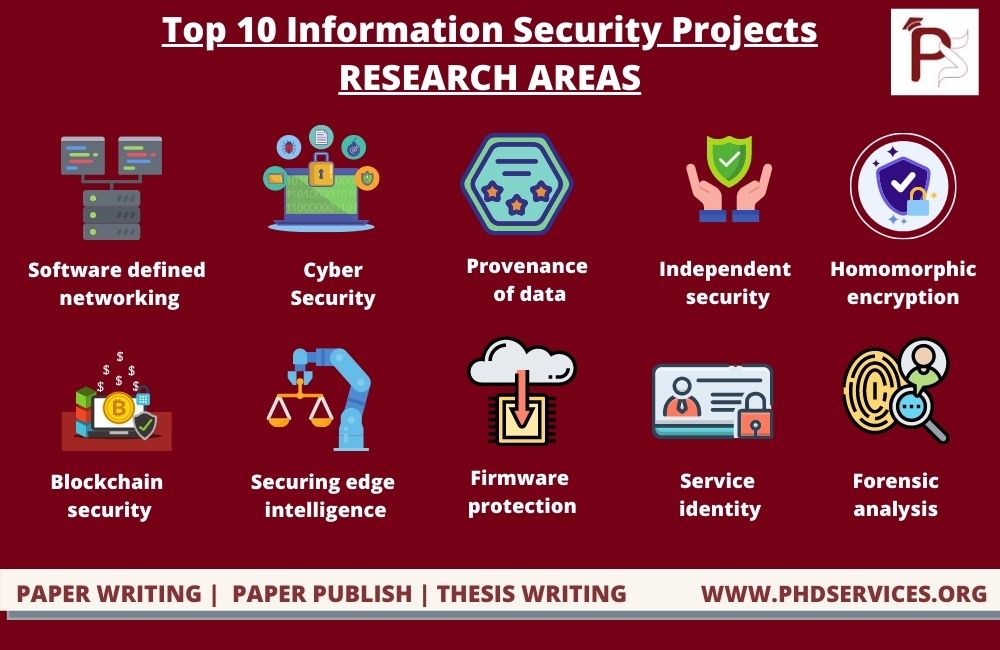
Top 10 Information Security Research Areas
- Software defined networking
- Cyber Security
- Provenance of data
- Independent security
- Homomorphic encryption
- Blockchain security
- Securing edge intelligence
- Firmware protection
- Securing behavioral analytics
- Service identity and container security
- Evidence collection and forensic analysis
Suppose you want to feel more contended with information security apart from our suggestion on the trending topics of information security projects. In that case, we are able to provide you more ideas on the information security project as given below.
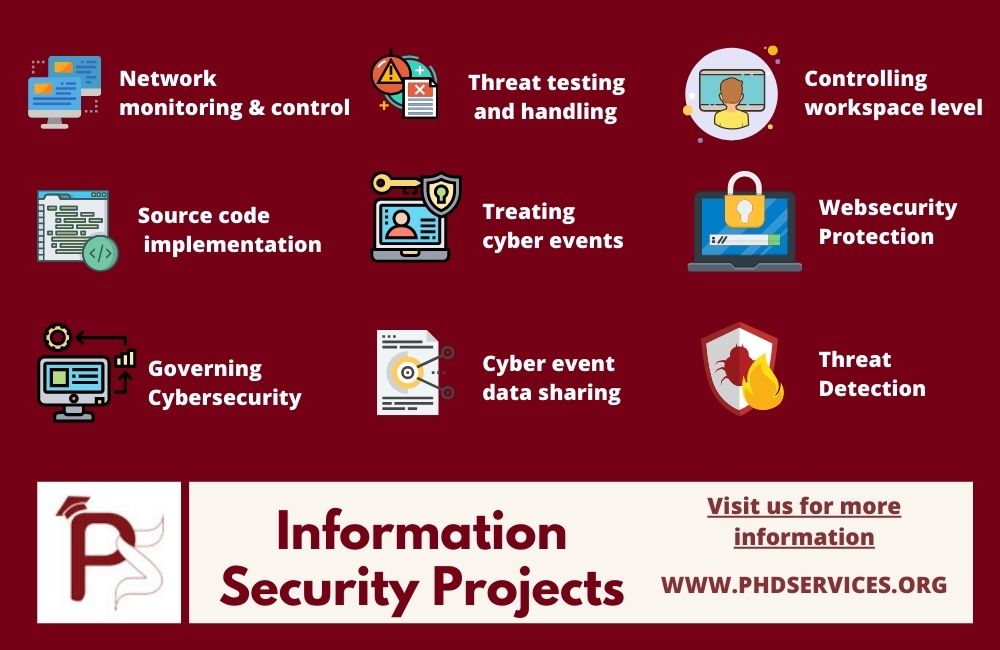
Information Security Project Ideas
- Securing Data: Digital Signatures, Authenticating Messages, and Cryptography
- Cryptography: Random Number Generations, Side-Channel Attacks, Quantum Cryptography, Public Key, Encryption, Ciphers.
- Computer security: Computer crime and hacking, Permissions, Firewalls, Authentication, Identity Management systems
- Access Control: Security Based On Capability, and Authorization
Our teams of researchers are here to provide you practical explanations on the key terms and procedures of information security without letting you struggle while explaining or justifying your project. We have more than 5000+ happy customers in the related field, and we have 100+ engineers in the cyber and information security field to work on your information security projects. Here we provide you the types of information attacks and their targets as listed below.
Types of Information Attacks
- Vulnerability
- Weak password
- Compromised key
- Software vulnerability
- Operating System vulnerability
- Vector Attack
- Lacking Authentication
- XSS
- Malware
- Social Engineering
- Target attack
- Products
- Machine Manufacturing
- Intellectual Property
- Impact of attack
- Confidentiality attack
- Integrity / structure attack (internal void, vertex movement, protrusion, scaling)
- Material attack (color, rough surface, strength of material)
The above attacks and their impacts are common in the information security projects domain. Here we provide you the methods involved in the information security for the efficient functions of the model. The following methods are commonly used in data security.
What are the methods of information security?
- Homomorphic encryption
- Quantum cryptography
- Post-quantum cryptography
- Authenticating messages
- Hash functions
- Random Number Generations
- Multi-party computational security
- Arithmetic cryptograph foundations
- Managing crypto materials
- Functional encryption
- Tools, techniques and methodologies of Cryptanalysis
- Asymmetric / symmetric cryptography
What is cryptography in information security?
Cryptographic technology is more important than any security measures in the information technology domain. “It protects the data before any malicious threat accessing the data.” It prevents the adversary from tapping the network security wire to spoof any sensitive data. The common use of visual cryptography is to encrypt or decrypt the data electronic data transmission. The functions of cryptography may vary according to the taxonomy discussed above.
Cryptography Algorithms for Information Security
- Symmetric Key: includes SERPENT, MARS, IDEA, RC6, CAST-128, TEA, 3DES, RIJNDEAL, TWOFISH, BLOWFISH
- Asymmetric key: includes SSH, RSA, SSL, DH
The method of cryptography enriches the protection in a secured network by encrypting and decrypting the raw data. Most of the cryptographic techniques come under the main symmetric, asymmetric category. So whatever you choose the algorithm, we request you to mind the following categorization of our symmetric cryptographic algorithms that varies in accuracy, efficiency, and security.
What are the cryptography algorithms?
- RSA
- Structure: Factorization
- Key Length: Multi Prime and Multi Power RSA
- Known Attacks: Factoring the Public Key
- RC6
- Structure: Feistel
- Key Length: 128-2048, key length in multiples of 32
- Known Attacks: Analytical & Brute Force Attacks
- AES
- Structure: substitution-permutation
- Key Length: 256 key length in multiple of 64
- Known Attacks: side-channel attack
- IDEA
- Structure: substitution-permutation
- Known Attacks: differential timing & key scheduling attack
- BLOWFISH
- Structure: Feistel
- Key Length: 64-448 key lenght in multiples of 32
- Known Attacks: dictionary attack
- CAST-128
- Structure: feistel
- Key Length: 128 & 256 bits
- Known Attacks: chosen plaintext attack
- 3DES
- Structure: Feistel
- Key Length: extended from 56 to 168 bits
- Known Attacks: Brute Force Attack, Chosen Plaintext, Known Plaintext
The mentioned function of the cryptography algorithm varies at the level of network and application.
- At network Level: where hardware encryption modules are kept in the network level, the hardware encryption will takes place.
- At Application Level: before an unauthorized access took place, a specific application performs the encryption process.
What are the goals of lightweight cryptography?
- High performance system
- Customized CPU
- Crypto array
- Crypto multicore
- Crypto processor
- Lightweight hash function
- Smaller messages sizes
- Smaller output size
- Lightweight block cipher
- Simpler key schedules
- Simpler rounds
- Smaller key sizes
- Smaller Block sizes
- Low Source device: it divides into S/W and H/W platform where the S/W platform has the goals to perform by depending or independent on the machine. The H/W platform performs to achieve FGPA, ASIC, Full custom and
Lightweight cryptography has more attributes for its functions except for the lightweight stream cipher. Along with the goals of lightweight cryptography, we provide you certain programming in information security areas to overcome the threats in information security projects that you needed to know as follows.
- Improving Cybersecurity Software: the tools involved in the program are Cryptography, Firewall and Antivirus
- Testing Penetration: it is very important program than any other information security programs privileged
- Analyzing Malware: in this work, we help you to understand such programing language
- Security Code: this programming tool used to secure software, web applications and helps to write securing software.
The abovementioned programs are core basics than other programming languages. Learning these programs will help you in detecting and mitigating the threats or attacks at the initial level. Some programs have the ability even to prevent the attacks. We help you to learn the basics of the programs in addition to working on your information security projects. We are having plenty of engineering resources, mainly in the cyber field. Working on your project with us will give you an unbelievable research outcome, and you can enrich in-depth subject knowledge. So don’t miss the opportunity to hold our hands!!
“Information Security aims to provide a reading access only to the people you aimed to share.”