


Are you facing challenges to choose parameters in your cellular network research?
We provide Cellular Network PhD Dissertation Writing Assistance by addressing key challenges using advanced mobility management models, incorporating adaptive handover decision algorithms based on parameters such as RSRP, RSRQ, SINR, and user equipment velocity. Our approach integrates RL-based handover policies and load-aware cell selection techniques to mitigate unnecessary handovers and reduce ping-pong effects. By utilizing multi-tier HetNet architectures, dual connectivity, and SDN-enabled control, we ensure seamless session continuity and enhanced QoS/QoE across dynamic radio environments, delivering strong, technically robust, and publication-ready Cellular Network PhD dissertation outcomes.
- Cellular Network Dissertation writing Services
From Cellular Network PhD dissertation writing assistance, we support scholars in developing advanced, research-driven academic work. Our expertise covers 5G NR, HetNets, and B5G/6G architectures with strong protocol-level analysis and system modeling. We ensure accurate simulation, performance evaluation, and global standards compliance to deliver high-quality, publication-ready dissertation outcomes.
- Expert Cellular Network Dissertation Guidance
PhDservices.org provides advanced support in 5G NR, HetNets, and B5G/6G architecture modeling with deep protocol-level understanding.
- Advanced Network Simulation Support
We use industry-standard simulation platforms to ensure accurate modeling and validation of complex cellular network systems.
- Strong Performance Evaluation Metrics
Our experts analyze key parameters such as SINR, throughput, latency, and spectral efficiency for reliable research outcomes.
- 3GPP Standards Compliance
We ensure your dissertation aligns with global 3GPP standards for technical accuracy and industry relevance.
- Innovative Research Problem Formulation
We help design strong, impactful research problems with clear objectives and real-world applicability.
- Reproducible Experimental Frameworks
Our methodology ensures structured, repeatable experiments for strong academic validation.
- High Technical Depth Analysis
We provide in-depth protocol analysis and system-level insights for complex cellular network research.
- Publication-Ready Dissertation Output
We refine your work to meet journal and conference publication standards with strong academic quality.
- End-to-End Dissertation Support
From topic selection to final submission, we provide complete assistance for your PhD journey.
- Pioneering Research Contributions
We help you deliver innovative findings that contribute meaningfully to next-generation cellular network technologies.
- Cellular Network Dissertation Topics
We provide Cellular Network PhD Dissertation Writing Assistance with in-depth exploration of advanced paradigms such as network slicing, carrier aggregation, URLLC, and self-organizing networks. We identify high-impact research topics through systematic gap analysis, traffic modeling, and evaluation of C/U-plane separation strategies in evolving RAN architectures. We incorporate concepts like CoMP and radio resource scheduling to ensure innovative and technically rigorous topic selection. Our expertise ensures the development of novel, feasible, and journal-ready PhD dissertation topics with strong practical relevance in cellular networks.
Advancements in 5G-Advanced and 6G architectures serve as the foundation for modern dissertation topics in cellular networks.
For carrying out an impactful dissertation, these topics are highly suitable:
- Evolution of cellular network architectural models
- Functional decomposition of cellular core networks
- Control-plane signaling mechanisms in cellular systems
- User-plane data routing architectures in cellular networks
- Virtualization techniques in cellular network design
- Cloud-native architectures for cellular networks
- Distributed cellular network architectural frameworks
- Hierarchical control models for cellular systems
- Network function orchestration in cellular environments
- Control signaling optimization architectures
- Automation frameworks for cellular networks
- Self-organizing cellular network architectures
- Network management plane design for cellular systems
- Architectural support for scalable cellular networks
- Fault management architectures in cellular networks
- Configuration management systems for cellular infrastructure
- Monitoring frameworks for cellular network operation
- Reliability-oriented cellular network architectures
- Control-plane security architecture in cellular systems
- Policy-driven management architectures
- Architectural support for diverse cellular services
- Multi-layer architectural models for cellular networks
- Cross-domain coordination architectures
- Lifecycle management architectures for cellular networks
- Mobility-supporting cellular architectural designs
- Control- and data-plane separation architectures
- Network observability architectures in cellular systems
- Evolution-ready modular cellular architectures
- Modular and flexible cellular network design
- Emerging architectural paradigms for future cellular networks
For PhD and Master’s scholars, PhDservices.org provides expertly curated Cellular Network dissertation topics aligned with the latest advancements in 5G NR, HetNets, and B5G/6G technologies. Our topics focus on advanced areas such as network slicing, spectrum optimization, mobility management, and ultra-low latency communication systems. With strong academic relevance and industry-driven insights, we help scholars develop innovative, high-impact, and publication-ready research ideas.
- Foundational assessment metrics and system parameters in CN PhD dissertation
Foundational evaluation in a Cellular Networks PhD dissertation relies on rigorous analysis of system-level parameters such as CQI, path loss, and shadow fading under realistic channel conditions. Performance indicators including throughput, packet delivery ratio, and latency are quantified to assess network behavior. We incorporate advanced radio resource management metrics like scheduling efficiency, load balancing index, and fairness constraints in multi-cell environments. We also consider handover failure rate, and outage probability to capture network robustness in your PhD dissertation.
Cellular networks power global communication, linking billions of devices. Their performance is assessed through metrics that drive improvements in connectivity.
Such evaluations are vital for advancing next‑generation technologies and meeting growing user demands.
We listed out the important metrics that broadly applied in cellular networks.
- Signal-to-Noise Ratio (SNR)
- Signal-to-Interference-plus-Noise Ratio (SINR)
- Bit Error Rate (BER)
- Packet Error Rate (PER)
- Throughput
- Latency
- Jitter
- Packet Loss Rate
- Call Drop Rate
- Handover Success Rate
- Channel Utilization
- Spectral Efficiency
- Energy Efficiency
- Coverage Probability
- Quality of Service (QoS) Index
- Quality of Experience (QoE)
- Traffic Load
- Cell Capacity
- Uptime
- Network Reliability
Through comprehensive comparative analysis and result justification, we evaluate all key parameters and performance metrics to ensure accurate, reliable, and research-driven outcomes. Our approach focuses on technical precision, structured validation, and detailed result interpretation to strengthen dissertation quality and research credibility. For more details, contact phdservicesorg@gmail.com or reach us at +91 94448 68310 for expert assistance and support.
- Cellular Network Research Challenges
We provide Cellular Network PhD Dissertation Writing Assistance by effectively addressing key research challenges through dynamic interference coordination using ICIC/eICIC mechanisms and adaptive spectrum reuse to manage congestion in dense deployments. Our specialists handle mobility complexities using fast cell reselection and predictive mobility profiling to ensure seamless service continuity. We further enhance network resilience by implementing secure key exchange mechanisms and optimized signalling procedures, delivering strong, technically validated, and publication-ready dissertation outcomes in cellular networks.
Addressing research challenges in cellular networks requires overcoming the technical bottlenecks that impede performance and scalability. This involves improving spectrum use, energy efficiency, security, and connectivity.
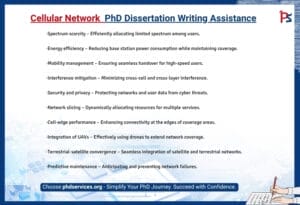
Critical, systemic challenges within cellular network involve:
- Spectrum scarcity – Efficiently allocating limited spectrum among users.
- Energy efficiency – Reducing base station power consumption while maintaining coverage.
- Mobility management – Ensuring seamless handover for high-speed users.
- Interference mitigation – Minimizing cross-cell and cross-layer interference.
- Security and privacy – Protecting networks and user data from cyber threats.
- Network slicing – Dynamically allocating resources for multiple services.
- Cell-edge performance – Enhancing connectivity at the edges of coverage areas.
- Integration of UAVs – Effectively using drones to extend network coverage.
- Terrestrial-satellite convergence – Seamless integration of satellite and terrestrial networks.
- Predictive maintenance – Anticipating and preventing network failures.
- AI-driven traffic optimization – Using machine learning for dynamic resource allocation.
- IoT connectivity – Supporting massive numbers of low-power IoT devices.
- mmWave deployment – Overcoming propagation challenges in urban environments.
- Edge computing scalability – Efficiently managing computing resources at the network edge.
- Energy harvesting – Integrating renewable energy sources in network infrastructure.
- Interoperability – Ensuring smooth operation across heterogeneous networks.
- QoE assurance – Maintaining consistent quality for multimedia services.
- Network densification – Optimally deploying small cells to increase capacity.
- Cognitive radio adoption – Dynamic spectrum access in underutilized bands.
- End-to-end reliability – Guaranteeing stable communication across the entire network.
With over 19+ years of research experience and the strength of our highly skilled technical team, we deliver the best solutions for all types of research challenges across diverse academic domains. Our expertise combines strong methodological knowledge, advanced technical support, and innovative problem-solving approaches to ensure high-quality and reliable research outcomes. We are committed to guiding scholars with end-to-end assistance, helping them overcome complex challenges and achieve academic excellence with confidence.
- Cellular Network Dissertation Ideas
Cellular Network dissertation ideas are developed by exploring advanced domains such as uplink power control, beam management procedures, NOMA, and IAB in next-generation systems. We derive research directions through analytical problem decomposition, research gap isolation, and requirement mapping. Our specialists refine topics by examining protocol stack enhancements, MAC layer scheduling mechanisms, and control signalling optimization in complex cellular environments. This structured methodology enables us to deliver research-intensive and publication-ready dissertation ideas in cellular networks.
Effective dissertation ideas address the dual challenges of efficiency and security in 5G/6G systems. By focusing on spectrum management and IoT integration, this research provides the innovation required to sustain evolving mobile network demands.
Ideas that provoke the curiosity of researchers in this area are:
- Autonomous operation models for cellular networks
- Zero-touch configuration and management frameworks
- Self-healing mechanisms in cellular infrastructures
- Intent-driven control paradigms for cellular networks
- Cognitive and learning-enabled cellular systems
- Sustainable and eco-friendly cellular network ecosystems
- Fully virtualized next-generation cellular infrastructures
- User-aware adaptive cellular network models
- Context-aware service delivery in cellular systems
- Intelligent governance models for cellular networks
- Green cellular network evolution strategies
- Human-centric design philosophies for cellular systems
- Policy-aware adaptive cellular networks
- Trust-centric cellular network frameworks
- Ethical design principles for future cellular networks
- Resilient cellular infrastructures for critical services
- Service-centric evolution of cellular networks
- Knowledge-driven cellular network intelligence
- Predictive intelligence in cellular network operation
- Experience-oriented cellular network design
- Fully automated cellular network lifecycles
- Adaptive service-aware cellular architectures
- Collaborative and open cellular ecosystems
- Programmable and open cellular network platforms
- Evolution beyond traditional cell-based networking
- Autonomous service provisioning in cellular networks
- Long-term governance of mobile network ecosystems
- Cellular networks supporting societal resilience
- Intelligent spectrum ecosystem visions
- Long-range evolutionary pathways for cellular networks
- Direct Consultation with Academic Writing Experts
Call us – +91 94448 68310
Whatsapp – +91 94448 68310
Mail ID – phdservicesorg@gmail.com
URL – PhDservices.org
- Our Record of High-Quality Dissertation Deliveries

| Post Doctorate Dissertation | Doctoral Dissertation | Paper writing | Master Dissertation |
| 540 + | 910 + | 1565+ | 1850+ |
- Logical section design and hierarchical structuring in Cellular Network research
We provide Cellular Network PhD Dissertation Writing Assistance with a logically structured section design that ensures a coherent flow from system modeling to performance evaluation across complex network architectures. Our experts organize content to clearly reflect dependencies between radio resource management, mobility handling, and interference coordination mechanisms. This structured approach enhances readability, technical clarity, and systematic validation of research outcomes, ensuring a strong, well-organized, and publication-ready Cellular Network PhD dissertation.
- FRONT MATTER COMPONENTS
- Dissertation Identification Page
- Comprehensive title aligned with cellular network focus areas such as waveform design or network optimization
- Researcher credentials including name, academic unit, institution, and submission timeline
- Details of research advisors and affiliated organizations
- Originality Confirmation & Compliance Statement
- Declaration ensuring independent work and adherence to academic integrity policies
- Certification meeting institutional and ethical research guidelines
- Acknowledgment Section
- Formal recognition of supervisory guidance, funding agencies, and technical support contributors
- Research Synopsis
- Brief overview (250–350 words) outlining objectives, methodological framework, experimental validation, and technical contributions
- Focus on innovation in communication systems, transmission techniques, or protocol enhancements.
- Index of Technical Terms
- Selection of key domain-specific terminologies such as beamforming, carrier aggregation, RF front-end, and SDR frameworks
- Symbolic and Abbreviation Register
- Organized list of mathematical symbols and acronyms including metrics and standards used throughout the research
- PRIMARY TECHNICAL CONTENT
- Problem Context & Communication Constraints
- Examination of research gaps in areas such as wireless propagation, signal processing, and network protocol efficiency
- Analysis of system limitations involving channel variations, frequency offsets, and protocol overhead
- Formulation of objectives targeting reliability, data integrity, and efficient spectrum utilization
- Contemporary Research Survey
- Analytical review of existing transmission schemes, coding methodologies, and communication models
- Identification of shortcomings in current system designs and hybrid implementation approaches
- Analytical Modeling & Framework Design
- Development of system-level representations for communication processes and signal transmission models
- Mathematical abstraction of link structures, bandwidth allocation, and reuse strategies
- Specification of operational assumptions, constraints, and evaluation indicators
- Computational Strategy & Simulation Design
- Configuration of experimental setups with defined parameters and protocol behaviors
- Execution of algorithmic models for system validation and performance assessment
- Ensuring consistency, repeatability, and accuracy in computational outcomes
- Prototype Development & Integration
- Realization of communication modules using programmable hardware and embedded platforms
- Synchronization of simulated models with real-time experimental environments
- Inclusion of architectural diagrams, processing workflows, and algorithmic structures
- System Evaluation & Quantitative Analysis
- Measurement of performance indicators such as signal quality, transmission rate, efficiency, and power utilization
- Comparative assessment against reference communication systems
- Evaluation across diverse propagation conditions and traffic intensities
- Optimization Mechanisms & Robustness Improvement
- Application of adaptive transmission schemes and intelligent control strategies
- Efficient allocation of network resources for scalable system performance
- Implementation of techniques for interference suppression, noise control, and signal fidelity enhancement
- Key Contributions & Applied Significance
- Presentation of innovative solutions in communication technologies and system efficiency improvements
- Impact on both theoretical advancements and practical deployment scenarios
- Conclusion & Prospective Extensions
- Consolidation of technical outcomes and research insights
Recommendations for future exploration in advanced communication domains
- Consideration of emerging paradigms such as intelligent networks, integrated communication systems, and next-generation wireless technologies
- BACK MATTER AND SUPPORTING ELEMENTS
- Reference Compilation
- Structured citation of scholarly articles, technical standards, and research documentation
- Supplementary Documentation
- Inclusion of implementation details such as source code, configuration setups, and extended analytical derivations
- Additional materials including system schematics, topology representations, datasets, and experimental records
- Modeling and simulation environments for Cellular Network research
We provide Cellular Network PhD Dissertation Writing Assistance with advanced modeling and simulation environments that enable detailed analysis of radio propagation, channel fading characteristics, and user mobility patterns in complex deployment scenarios. We utilize these environments to evaluate protocol stack behavior, MAC layer scheduling, and radio resource allocation under varying traffic loads. Our specialists further analyze performance aspects such as link adaptation and interference coordination, ensuring technically rigorous, well-validated, and publication-ready Cellular Network PhD dissertation outcomes.
By replicating real‑world scenarios, simulation tools help evaluate and enhance cellular network efficiency.
Simulation tools bring the following advantages:
- Helps refine network parameters, resource allocation, and protocol efficiency before real-world implementation.
- Detects flaws early to prevent failures.
- Measures throughput, latency, and coverage.
- Assesses networks without real deployment.
Most prevalent simulation tools are:
- NS-3 (Network Simulator 3) – Open-source simulator for modeling and evaluating wired and wireless network protocols.
- OMNeT++ – Discrete event simulation framework for network and communication system analysis.
- MATLAB/Simulink – Provides simulation and modeling tools for wireless communications and signal processing.
- OPNET / Riverbed Modeler – Enables detailed performance modeling of cellular and mobile networks.
- QualNet – High-fidelity network simulator for large-scale wireless and cellular systems.
- GloMoSim (Global Mobile Simulator) – Simulates large-scale wireless networks using parallel discrete-event simulation.
- NetSim – Comprehensive network simulator for designing and testing mobile and cellular networks.
- AnyLogic – General simulation tool supporting discrete-event, agent-based, and system dynamics modeling for networks.
- Arena Simulation – Discrete-event simulation software often used for communication system modeling.
- OMF (Orbit Management Framework) – Focused on experimental testbeds for wireless and cellular network research.
Along with the above-listed tools, we deliver specialized support aligned with your specific research problem statement. Our experts assist in selecting advanced simulation platforms, developing accurate computational models, and applying robust data analysis methodologies for precise research validation. We ensure end-to-end technical guidance that enhances methodological strength, improves result accuracy, and supports the delivery of high-quality, publication-ready dissertation outcomes.
- Testimonials
- Iran – Dr. Ali Reza Mohammadi
“PhDservices.org delivered excellent support for my Cellular Network dissertation. Their expertise in 5G system modeling and performance evaluation significantly improved my research quality.”
- China – Dr. Wei Zhang
“Their guidance in network optimization and large-scale simulation was highly professional. My dissertation became more structured, accurate, and publication-ready.”
- Australia – Dr. Emily Johnson
“Strong technical support in cellular architecture and mobility management. Their simulation expertise greatly enhanced the depth of my PhD research.”
- France – Dr. Antoine Dubois
“PhDservices.org provided outstanding assistance in spectrum allocation and interference analysis. Their structured approach improved both clarity and technical strength.”
- Jordan – Dr. Omar Al-Fayez
“Their support in cellular network design and performance metrics analysis was exceptional. It helped me complete my dissertation with confidence.”
- New Zealand – Dr. Sophie Williams
“Excellent expertise in 5G/6G network modeling and protocol analysis. Their guidance made my dissertation highly professional and research-focused.”
- Comprehensive Free Quality Enhancement Package
PhDservices.org dissertation delivery marks only the beginning of your academic journey. We extend a comprehensive suite of complimentary post-delivery academic support services designed to ensure your research meets the highest standards of originality, technical precision and doctoral-level excellence. Our continued expert assistance helps strengthen your work for academic validation, presentation quality, and publication readiness.
- Structured Dissertation Refinement Support
We revise your work based on supervisor feedback and academic requirements to improve clarity, accuracy, and research alignment.
- Advanced Methodology & Technical Guidance
Expert consultation to refine research methodology, strengthen analysis, and enhance conceptual clarity.
- Academic Integrity & Plagiarism Validation Report
Detailed originality assessment to ensure compliance with institutional academic standards.
- AI Content Authenticity Evaluation
Advanced verification to ensure transparency and confirm academic originality of the content.
- Language Precision & Academic Writing Enhancement
Comprehensive review to improve grammar, structure, coherence, and scholarly tone.
- Secure Research Confidentiality Assurance
Strong data protection protocols to safeguard your dissertation and personal research information.
- Interactive Live Expert Demonstration Sessions
One-to-one Google Meet sessions for detailed explanation, technical walkthrough, and viva preparation.
- Journal Publication Support Assistance
Expert guidance to transform your dissertation into high-quality manuscripts suitable for indexed journals and conferences.
- FAQ
- How do you assist with Cellular Network PhD dissertation topics?
We help formulate research problems based on advanced domains such as mobility management, resource allocation, and next-generation network architectures.
- Can you support complex cellular network modeling and analysis in my PhD dissertation?
Yes, we provide guidance on system-level modeling, protocol stack evaluation, and performance analysis using standard cellular frameworks.
- How do you ensure the technical quality of my cellular network PhD dissertation?
We follow rigorous methodologies including KPI-driven evaluation, analytical validation, and alignment with industry standards like 3GPP.
- How do you support algorithm development in cellular networks PhD dissertation?
We design and optimize algorithms for scheduling, power control, interference mitigation, and seamless connectivity.
- Do you provide assistance with result interpretation and validation in cellular network PhD dissertation?
Yes, we offer detailed analysis, comparative evaluation, and validation using analytical and performance-driven approaches.
- How do you ensure originality in my cellular network PhD dissertation?
We emphasize novel problem formulation, unique solution design, and strict plagiarism-free content development.
- Expanding Our Support Across Multiple Departments
Networking | Cybersecurity | Network Security | Wireless Sensor Network | Wireless Communication | Network Communication | Satellite Communication | Telecommunication | Edge Computing | Fog Computing | Optical Communication | Optical Network | Mobile Communication | Distributed Computing | Cloud Computing | Computer Vision | Pattern Recognition | Remote Sensing | NLP | Image Processing | Signal Processing | Big Data | Software Engineering | Wind Turbine Solar | Artificial Intelligence | Machine Learning | Deep Learning | AI LLM | AI SLM | Artificial General Intelligence | Neuro-Symbolic AI | Cognitive Computing | Self-Supervised Learning | Federated Learning | Explainable AI | Quantum Machine Learning | Edge AI / TinyML | Generative AI | Neuromorphic Computing | Data Science and Analytics | Blockchain | 5G Network | VANET | V2X Communication | OFDM Wireless Communication | MANET | SDN | Underwater Sensor Network | IoT | Quantum Networking | 6G Networks | Network Routing | Intrusion Detection System | MIMO | Cognitive Radio Networks | Digital Forensics | Wireless Body Area Network | LTE | Ad Hoc Networks | Robotics and Automation | Signals and Systems | Forensic Science | Psychology | Public Administration | Economics | International Relations | Education | Commerce | Business Administration | Physics | Chemistry | Mathematics | Computational Science | Statistics | Biology | Botany | Zoology | Microbiology | Genomics | Molecular Biology | Immunology | Neurobiology | Bioinformatics | Marine Biology | Wildlife Biology | Human Biology