


To maintain continuous communication, vertical handovers technology was introduced. The main task of vertical handover is to move from one wireless network/technology to another. On contrary, horizontal handover uses the same technology in between two access points. PhD Consultancy Services, vertical handover changes the technology of the data link layer to access the network layer.
This article furnishes the end-to-end details of vertical handover implementation which comprises limitations, techniques, input parameters, procedures, simulation tools, performance metrics, etc.!!!
What does Vertical Handover mean?
The vertical handover is working on the principle of changing the node’s connection type to connect with the supportive network automatically. For more clarity, if the device utilizes two different wireless network technologies to access the internet, then it automatically links with the available network too. This type of network changeover is referred to as the vertical handover.
However vertical handover has low cost in WLAN and high coverage in cellular networks, it also has high bandwidth and delay in the case of a greater number of vertical handovers at the large-scale network. To perform vertical handover, the following properties are considered.
Key Properties of Vertical Handover
-
- The devices that support VHO should comprise dual cards for lining wireless networks
- Compare the two linked wireless networks in terms of different VHO performance metrics for selecting an optimal network
- Take the VHO decision based on certain key elements as network state, user preferences, RSS, cost, user needs, etc.
On implementing vertical handover in a real-world environment, the followings constraints are needed to be solved effectively to accomplish seamless VHO. Our experts have designed several best-fitting solving techniques to overcome all possible limitations of VHO. Once you make a contact, we let you know the appropriate solutions. Here, we have given you only the primary limitations of vertical handover for your information.
Limitations in Vertical Handover
-
- Mobility Management
- Dual Mode (UMTS and WLAN)
- Insufficient Handover Parameters (For instance: RSS)
- Inefficient Handover Decision Technique
From that, we have identified the following elements (accuracy, reliability, and flexibility) that are challenging and lacking in previously proposed VHA techniques. So, we focus on these elements to untie the complexity of vertical handover implementation. Let’s have looked over them in the following,
Vertical handover algorithms
- Accurate Algorithm
- Precisely identify the essential data transfer rate for moving nodes in the network
- Reliable Algorithm
- Improve the VHD technique by correctly computing the cost of network capitals
- Flexible Algorithm
- Efficiently allocate the services to mobile nodes for stabilizing the traffic in the network
From the above list, you can find the major requirements of vertical handover algorithms. Our experts are best in satisfying these needs while developing VHO based on application requirements. Here, we have categorized the popular and effective VHD schemes in s5 classifications. These classifications are based on the main aspects of the VHO functionalities such as QoS, intelligence, received signal strength, context level, and decision-making function. Also, our developers have sufficient practice in all these schemes to assist you in the right direction of VHO research.
Schemes for Vertical Handover Decision
- QoS-based Schemes
- SINR-assisted
- User Profile-assisted
- Available Bandwidth-assisted
- Intelligence-based Schemes
- Intelligent Protocol-assisted
- ANN–assisted
- Fuzzy Logic-assisted
- RSS-based Schemes
- Channel Scanning-assisted
- Dwell Timer-assisted
- Prediction-assisted
- RSS Threshold-assisted
- Context-based
- Analytical Hierarchical Process-assisted
- MIH-assisted
- Mobility Prediction-assisted
- Mobile Agent-assisted
- Cooperation-assisted
- Decision Method-based Schemes
- Network Score Function-assisted
- Utility Function-assisted
- Cost Function-assisted
Next, we can see the input parameters commonly used for VHO project developments. The followings data are more useful to decide on vertical handover. As you knew already, the communication of network models is usually established over the OSI layers. So, here we have given you the input parameters based on the OSI layers starting from physical to application layers. Further, this may vary based on your project requirements. We surely assist you not only in the data collection phase but also up to the result analysis phase in VHO code development.
Input Parameters for VHO Implementation
- Physical
- Access media Availability
- Data Link
- Connection Status
- RAN Conditions
- Connection Parameters
- Network
- Topology
- Pre-authentication
- Routing
- Configuration
- Foreign agents availability
- Transport
- Network Traffic Load
- Available Bandwidth
- Network Traffic Load
- Application
- QoS Metrics
- Latency, Offered Bandwidth and Jitter
- User preferences
- Provider and Price
- Security Alarms
- Warnings
- Context Data
- Velocity
- QoS Metrics
The efficient and reliable VHO techniques should support metrics of both lower and upper layers of VHO architectures. For instance: user mobility models, current context, user preferences, QoS metrics, etc. Further, if you want to know the design of VHO techniques then approach us. We explain to you in detail to clear your doubts in every aspect of VHO implementation.
For illustration purposes, here we have given you the two different techniques used for implementing the vertical handover process. Particularly, these techniques have high performance of wireless networks utilizing SLA agreement and QoS.


Neural Network based Vertical Handover Implementation
- Create 3 entities as wireless device, handover manager and N number of candidate networks
- At first, wireless device send request to the handover manager
- Then, the handover manger run the network handler and feature collector on the basis of Artificial neural network technique
- In this, the ANN trains the data using ANN trainer and selects the optimal network from candidate collection through ANN selector
- At last, handover manager send the response to the wireless device
Fuzzy Logic based Vertical Handover Implementation
- At first, collect the input parameters as temperature, network load, user velocity and base station distance.
- Then, compute the channel capacity, RSS (mobile device) and SNR
- At last, identify the network which has high advantages by benefit value.
From our recent comprehensive study, we found that there are insufficient VHO performance assessments. In some cases, it considered only homogenous techniques and metrics. So, here we have given you the most extensively used performance metrics for efficient VHO.
On enhancing these parameters in heterogeneous networks, one can design seamless VHO in a dynamic environment. Most importantly, we support you to design and develop effective VHO techniques at any level of complexity. Since our experts know all smart ways to improve the following parameters in VHO techniques.
Performance Evaluation for Vertical Handover Implementation
- Packet Loss of VHO
- Success Rate of VHO
- VHO Delay
- Time for performing VHO event
- Ratio of Successful VHO events
- Collection Delay
- Time for collecting data to perform VHO
- Number of VHO
- Simulation Delay
- Time for executing VHO
- Total count of executed VHO events
- Decision Delay
- Time for taking decision over VHO
- Number of undelivered packets in VHO process execution
- Dwell Time
- Time for pausing VHO to let other process execution
Next, we can see the development tools for VHO projects. There is no standalone tool for VHO evaluation. So, many developers/scholars will prefer network simulators to assess the VHO process by making small adjustments. The adjustment may be small changes in existing modules or constructing new modules based on project needs.
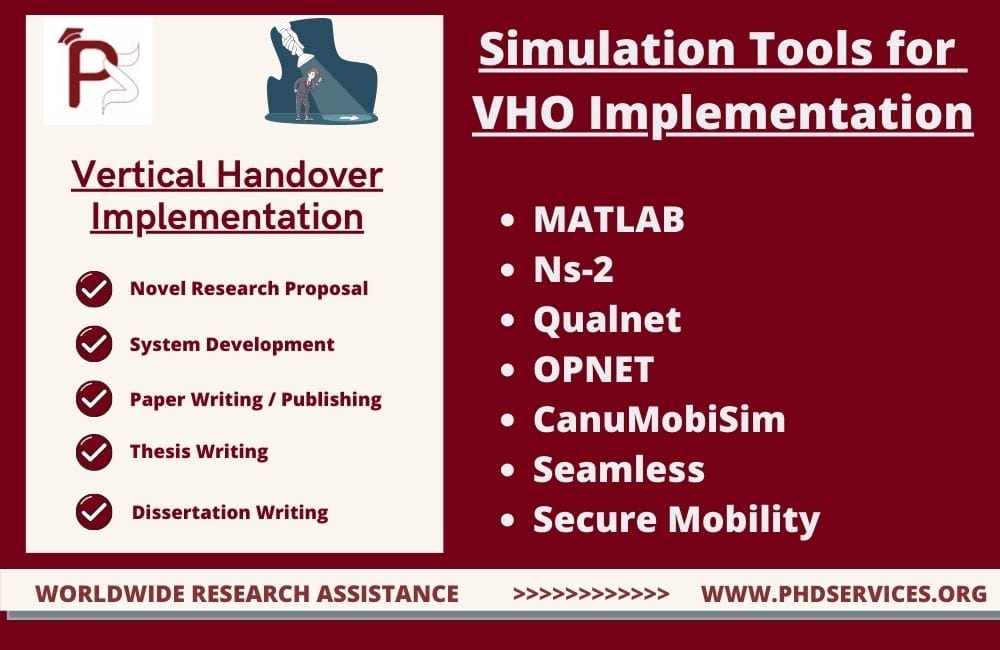
To assess the VHO process, one can use any of these methods: emulators, simulators, customized testbeds, and other hardware/software implementations. Here, we have given you the list of widely used simulation tools specifically works well for Vertical Handover implementation.
Simulation Tools for Vertical Handover Implementation
- MATLAB
- Ns-2
- Qualnet
- OPNET
- CanuMobiSim
- Seamless and Secure Mobility
Although there are several network simulation tools, only a few of them completely support VHO either directly or indirectly. Since, they are limited libraries, modules, architecture, and testbeds. The VHO techniques and schemes listed in the above section give the best results on following below specified network simulation tools. In our vertical handover implementation, we live and truly experienced the best results on using the below tools. So, we are adept to guide any of your interested tools to develop the best VHO project in wireless networks.
- Matlab
- Provide end-to-end support to mathematical models
- Flexible to define and improve VHO performance
- NS2
- Provide different wireless and wired technologies modules
- For instance: UMTS, IEEE 802.11b, IEEE 802.15.1 and IEEE 802.3
- Support VHO in heterogeneous environs
- Flexible to develop multi network topologies in different mobility protocols
- Offer 802.21 based VHO management for WAN technologies
- SHINE
- Specially intended for heterogeneous networks simulation
- Simple to execute VHO in overlapped networks
- Utilize core server for transport protocols, user management, mobility, etc. (upper layer)
- Address the client in every access technology (lower layer)
- Allow to regenerate the behavior of transport protocol
- Also, create instances for new traffic sessions from clients
- Supported Networks – Wi-Fi, GPRS, Wi-Max and UMTS
- OPNET
- Used to design and simulate wireless networking models
- Enable to alter code and configuration for VHO execution as well as assessment
- NS2-Miracle
- Expands as Muli-InteRfAce Cross Layer Extension (MIRACLE)
- Support to work with NS2 simulation tool
- Offer massive dynamic libraries for Multi and cross- layering technologies
- Enable several Wi-Max plugins
On the whole, we are pleased to inform you that we support you in every vertical handover research. And, if you are looking for the best VHO research topics and project development service then you can reach our team. We assure you that we provide step-by-step guidance in every phase of your research.
In addition to project development, we also provide plagiarism-free documentation support vertical handover implementation. So, we hope that you use this wonderful chance to make your research journey more peaceful without any research hurdles.





